


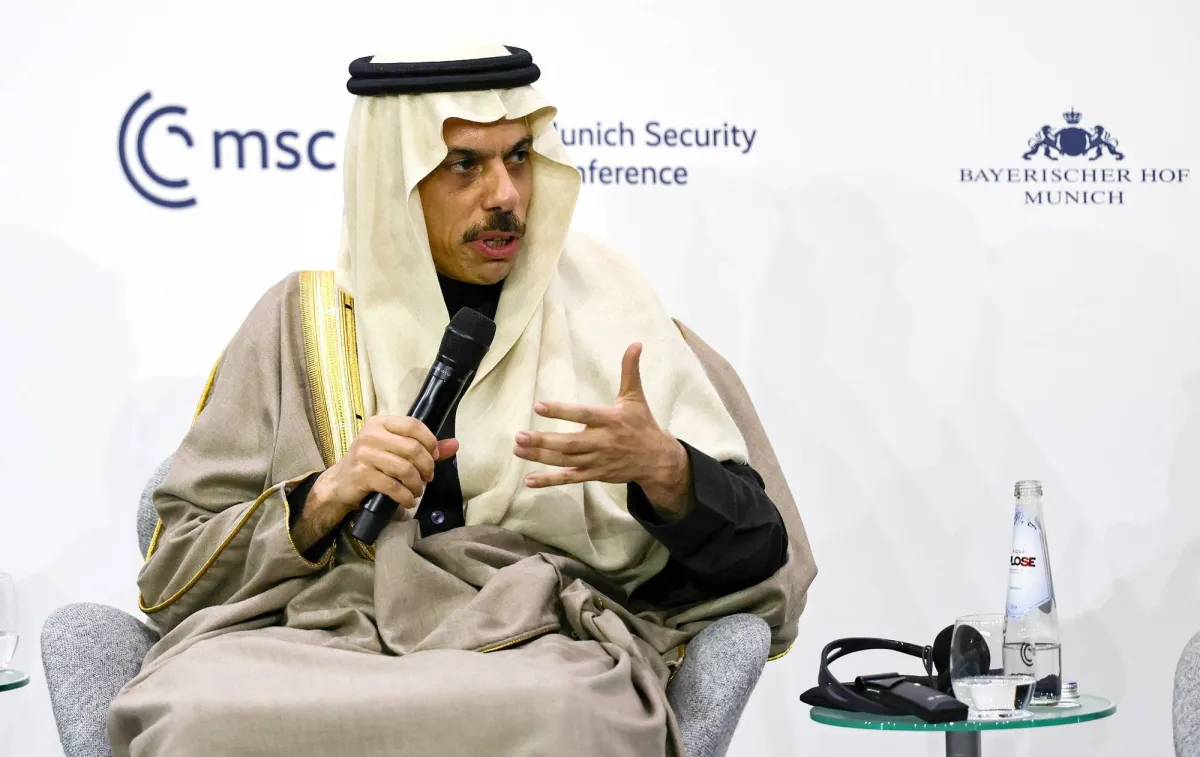
Saudi Arabia’s Foreign Minister Prince Faisal bin Farhan emphasized the unity of the Gaza Strip and the West Bank during a panel discussion at the Munich Security Conference, saying such unity could not be achieved without “stability in Gaza.”
Crown Prince Faisal said on Friday that Israel’s violations of the ceasefire agreement in Gaza are “ongoing,” noting that the bigger concern is not only the continuation of the fighting, but also that the deaths will not stop even during periods when the gunfire subsides.
He added that the delivery of humanitarian aid remained a major challenge.
The minister pointed to the gap between political promises and reality on the ground, saying that understanding does not always translate into action.
Nevertheless, he said it continues to address outstanding issues, whether related to ceasefire violations or paving the way for humanitarian access.
His remarks were made during a session entitled “Breaking Point: The International Order Between Reform and Destruction.”
In addition to Prince Faisal, the panel also included Colombian Defense Minister Pedro Arnulfo Sánchez Suarez, US Permanent Representative to the United Nations Michael Walz, and Caja Callas, EU Foreign Affairs Minister and Vice-President of the European Commission.
right to self-determination
Prince Faisal said it was clear that when the UN resolution establishing the Peace Commission was adopted, it contained clear language affirming the right of Palestinians to self-determination.
He said Saudi Arabia, along with the countries that signed the resolution and agreed to participate in the Council, sees this step as a milestone on the path to self-determination for the Palestinian people.
He stressed that the immediate priorities are to stop the loss of life in Gaza, stabilize the situation, begin reconstruction, build confidence that the enclave no longer poses a threat to neighboring countries, and pave the way for addressing Palestinian rights.
A genuine approach to Palestinian rights must be inclusive, including Palestinians in the West Bank, he said, adding that maintaining the “unity of Gaza and the West Bank” is essential.
He added that unity cannot be maintained without stability in Gaza, noting that it is difficult to unite or forge political lines amidst chaos.
Prince Faisal said efforts were ongoing and future meetings were scheduled to follow up on progress, stressing that achieving stability was a continuous and daily effort.
To send a clear political message, he said, there is now a need to focus on measurably improving the lives of Palestinians in the Gaza Strip and opening the door to a path where Palestinians and Israelis can coexist in peace and harmony.
changes in world order
Beyond the Palestinian issue, the meeting also addressed changes in the international system and the effectiveness of multilateral institutions amid rising tensions, growing security challenges, and a global economic crisis.
Prince Faisal said that the current system was originally formed against the backdrop of the European crisis that began with World War I and then led to World War II, which led to the creation of the United Nations and laid the foundations for the current world order.
That history explains the European or transatlantic focus built into the system’s structure, he said.
Prince Faisal said there were grounds for cautious optimism, noting that despite the suffering of multiple wars, discussions about the failure of the international system to achieve its intended objectives had become more prominent.
He said that while the United States is leading efforts to address flaws in the international system, the more important changes are in Europe’s domestic debate.
For a long time, he said, there was a strong obsession with symbolism over facts on the ground, an approach that at an early stage prevented substantive discussions about the causes of conflict in different regions and how to reduce it in order to end it.
Prince Faisal said discussions were now taking place more openly and transparently, including in European countries that were the strongest supporters of the old order and refused to admit it was no longer working, and that the change in tone had made him more optimistic than last year.
