


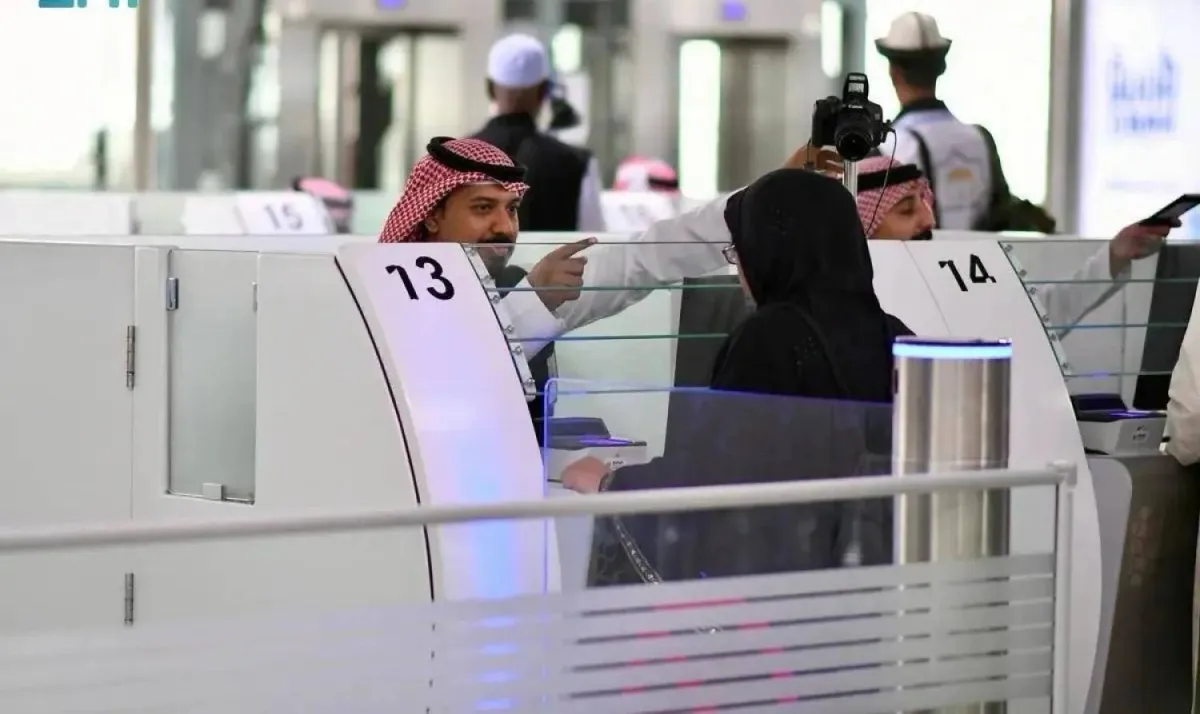
Saudi Arabia’s General Directorate of Passports leads the frontline operations of welcoming visitors and Umrah performers from around the world during the holy month of Ramadan, acting as the first point of contact for travel.
The Directorate, supported by an integrated operational system that combines trained personnel and advanced technology, is working to ensure smooth movement through international entry points, reflecting the level of institutional reforms underway across the Kingdom’s service and security sectors.
The use of technology and intensive training has made it possible to reduce processing times.
As the number of Umrah performers is expected to increase during the holy month, the General Directorate of Passports has strengthened operational preparations at air, land and sea ports under a plan aimed at reducing processing times, improving the quality of services and enhancing the pilgrimage experience from arrival to departure.
The official spokesperson of the General Directorate of Passports, Major Nasser Al-Otaibi, told Asharq Al-Awsat that the Directorate is focused on facilitating entry and exit procedures for Umrah performers at all international ports through a comprehensive operational plan.
These include speeding up travel procedures through the deployment of trained personnel, the provision of modern technological equipment and the use of advanced electronic systems, with the aim of completing the process smoothly and reducing congestion and waiting times.
Al Otaibi said the department has introduced the latest technology and smart systems as part of this season’s operational plan, contributing to expediting entry and exit procedures and ensuring smooth movement at all ports.
The latest technology allows travelers to complete the process independently in record time.
It added that these technologies and systems help reduce processing times and improve service quality. The integrated technology system aims to achieve the highest level of operational efficiency and reflect developments in passport services to improve the pilgrim experience.
Regarding coordination with other organizations, Al Otaibi said the integration of the Directorate General of Passports with other security and service agencies is a key element in improving performance on the ground, especially during high population seasons such as Ramadan.
He said the Directorate operates within an integrated security and services system that includes relevant security and other authorities.
This integration relies on direct technical collaboration, facilitating rapid verification of information, procedural accuracy, and timely decision-making.
Advance coordination can also help unify flight plans, deploy personnel, and manage passenger flow within travel venues to ensure smooth travel and reduce waiting times without compromising safety.
Al Otaibi said the collaboration reflects the concept of a “single system”, where roles are integrated across departments to achieve the unified goal of efficiently serving pilgrims while enhancing security and safety at entrances.
Regarding training and reducing processing times, the spokesperson said that the continuous qualification and training program of passport officers has a direct and visible impact on the quality of services provided to Umrah performers, especially during peak periods when high preparation and quick performance are required.
He emphasized that the Directorate runs specialized training programs covering crowd management and working under pressure, as well as regulatory and technical skills, as well as skills in dealing with a multilingual and multicultural public.
This training improves the ability of personnel to complete procedures accurately and quickly while maintaining a humane approach in dealing with pilgrims.
Mr. Al Otaibi said the training had achieved tangible results, including reduced processing times, increased pilgrim satisfaction, and an effective balance between speed and safety requirements, reflecting the professionalism of national executives serving pilgrims.
Saudi Arabia is currently experiencing a large influx of Umrah performers from abroad, which, along with domestic pilgrims, usually peaks on the last day of Ramadan. This season is expected to post higher numbers compared to the same period last season, especially considering the strong numbers released at the beginning of the month.
On Saturday, the 4th day of Ramadan, the Grand Mosque saw around 904,000 Umrah performers, the highest number since the beginning of the month.
Previously, Saudi Arabia announced that the number of Umrah performers and worshipers who visited the Two Holy Mosques during Ramadan in 2025 reached approximately 102,286,712.
Of these, more than 16 million were Umrah performers, while 75,573,928 worshipers at the Grand Mosque and 30,154,543 worshipers at the Prophet’s Mosque, all of whom were offered prayers from arrival to departure.
