


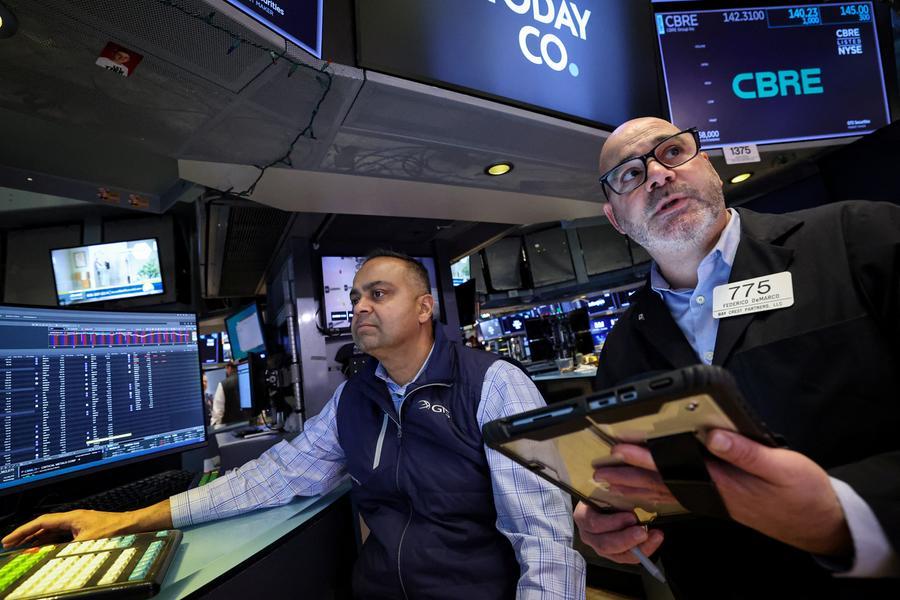
U.S. stocks managed to post some modest gains on Tuesday after struggling in early trading, with technology stocks rebounding from earlier lows and financial stocks also finding support.
After falling as much as 1.5% at the session’s low, the S&P 500 information technology sector erased losses to close 0.5% higher as gains in Nvidia and Apple overcame declines in Microsoft and Oracle.
Concerns that artificial intelligence will disrupt business models led to falls in software companies, brokerages and trucking companies last week, with Wall Street’s three main indexes posting their biggest weekly declines since mid-November.
“There are a lot of trends going on in terms of where investors want to put their money right now,” said Tim Ghriskey, senior portfolio strategist at Ingalls & Snyder in New York. “This market just sees spikes and dips on a regular basis, if not every day.”
“The market here is taking a very short-term view and AI will once again be heavily favored.” Potential risks from Chinese AI players compounded the uncertainty. On Monday, Alibaba announced Qwen 3.5, a new AI model designed to independently perform complex tasks.
Despite the rebound in technology stocks, software stocks remained under pressure, with the S&P 500 Software Index ending down 1.6%, and Intuit and Cadence Design, the worst performers in the index on the day, down more than 5%.
The Dow Jones Industrial Average rose 32.26 points, or 0.07%, to 49,533.19, the S&P 500 rose 7.05 points, or 0.10%, to 6,843.22, and the Nasdaq Composite Index rose 31.71 points, or 0.14%, to 22,578.38.
The S&P 500 Financial Index was the best performer among the 11 major S&P sectors on the day. Rising bank stocks such as Goldman Sachs and JPMorgan Chase & Co. pushed the Dow Jones Industrial Average into positive territory from an early 0.7% drop. Consumer staples fell 1.5%, the worst-performing S&P 500 sector in the session, dragged down by a 7% decline in General Mills after the cereal maker cut its full-year core sales and profit forecasts.
This week, the focus will be on the Consumer Expenditure Report, the Federal Reserve’s preferred measure of inflation, for insights into inflation and how it could affect the central bank’s rate-cutting trajectory. The data comes after last week’s weaker-than-expected consumer inflation data slightly raised hopes for a rate cut this year.
Traders are pricing in a roughly 63% chance that the Fed will cut rates by at least 25 basis points in June, the first time the probability has exceeded 50%. Chicago Fed President Austan Goolsby said the central bank could approve “several more” rate cuts this year if inflation resumes its decline to the central bank’s 2% target, and President Michael Barr said further central bank rate cuts could occur at some point well into the future as risks to the U.S. inflation outlook continue. In addition, San Francisco Fed President Mary Daly said the central bank needs to thoroughly examine the data to determine whether AI is boosting productivity growth and, by extension, economic growth, without reigniting inflation and forcing monetary tightening. Norwegian Cruise Line shares rose 12.1%, the best performer in the S&P 500 after activist investor Elliott announced he had acquired more than 10% of the cruise line. Fiserv stock rose 6.9% after the Wall Street Journal reported that activist investor Jana Partners had acquired a stake in the company. Masimo soared 34.2% and Danaher stock fell 2.9% after Danaher announced it would buy the pulse oximeter maker for $9.9 billion, including debt.
On the New York Stock Exchange, advancing issues outnumbered declining issues by a 1.02-to-1 ratio, and on the Nasdaq, declining issues outnumbered advancing issues by a 1.07-to-1 ratio.
The S&P 500 recorded 42 new highs and 10 new lows in 52 weeks, and the Nasdaq Composite Index recorded 81 new highs and 224 new lows.
Trading volume on U.S. exchanges was 17.76 billion shares, compared to an average of 20.7 billion shares traded over the past 20 trading days. (Reporting by Chuck Mikolajczak in New York; Additional reporting by Purvi Agarwal and Twesha Dikshit in Bengaluru; Editing by Pooja Desai and Matthew Lewis)
