


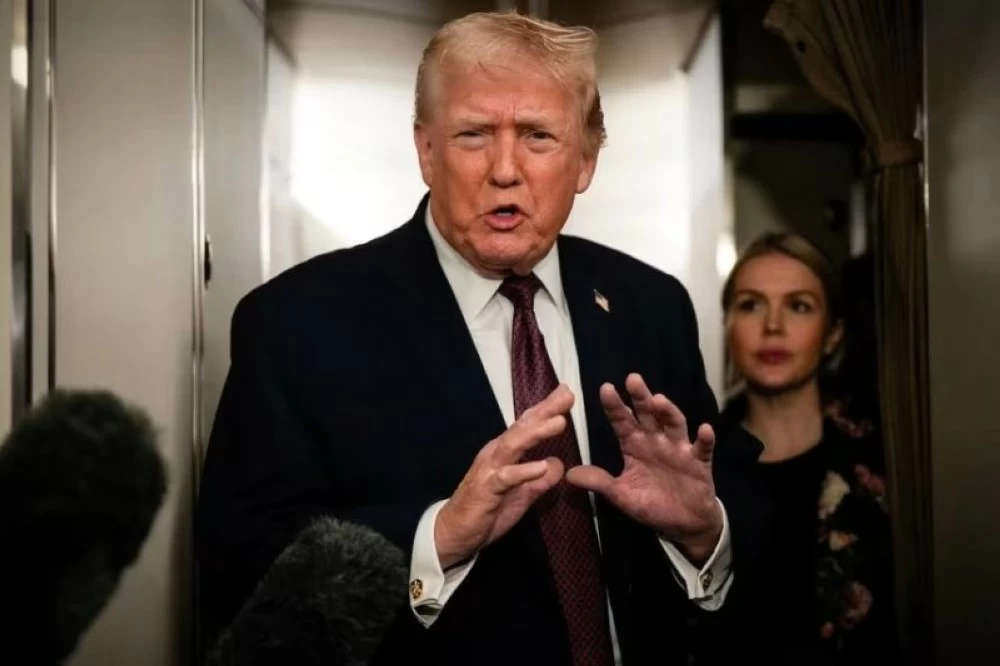
WASHINGTON – A senior national security official has told President Donald Trump that the U.S. military is prepared to strike Iran as early as this weekend, following a significant build-up of air and naval assets in the Middle East in recent days, according to multiple U.S. media reports.
President Trump has not made a final decision on military action and is consulting with his allies’ top advisers on the issue.
Meanwhile, the White House is assessing the risk of escalating tensions in the region and the political and military implications of curbing them, but its rhetoric has escalated in recent days despite talks between Washington and Tehran in Geneva.
“If Iran decides not to enter into a deal, the United States may need to use its airfields in Diego Garcia and Fairford to root out a potential attack by a highly unstable and dangerous regime,” President Trump wrote on Truth Social on Wednesday.
“(Trump) is fed up. Some people around him have warned him not to go to war with Iran, but I think there’s a 90% chance of violent action in the coming weeks,” one Trump adviser told Axios.
Sources have told US media that any US military operation is likely to be a large-scale, multi-week operation jointly with Israel, and that the Trump administration is “closer than most Americans think” to a major war in the Middle East.
U.S. officials said the arrival of the aircraft carrier USS Gerald Ford in the Eastern Mediterranean within the next few days will be a key factor in determining the timing of the attack.
The Pentagon plans to temporarily withdraw some personnel from the Middle East to the United States or Europe within three days in preparation for possible U.S. action or Iranian retaliation, CBS reported, citing U.S. officials.
Iranian and U.S. negotiators exchanged a memorandum of understanding for three and a half hours during indirect talks in Geneva on Tuesday, but departed without a clear solution. Iran’s top negotiator said the two sides had agreed on a “set of guidelines,” but a U.S. official said “there are still many details to discuss.”
Vice President J.D. Vance said on “The Story with Martha McCallum” that although the negotiations went well in some ways, President Trump had set a red line that “Iran has no intention of actually acknowledging and working on it yet.”
Related articles
US to withdraw troops from Syria amid rising tensions with Iran
White House press secretary Caroline Levitt said Wednesday that Iran plans to provide more detailed information on its negotiating position “in the coming weeks,” but did not say whether Trump would refrain from military action in that time.
US Secretary of State Marco Rubio is scheduled to visit Israel on February 28 to meet with Israeli Prime Minister Benjamin Netanyahu and update him on the Iran negotiations, a State Department official told CNN on Wednesday.
“I’m not going to set a deadline on behalf of the president of the United States,” Levitt said.
“Diplomacy is always the president’s first option,” he said, but added that military action remained a possibility.
“Iran would be wise to strike a deal with President Trump and his administration,” she said.
After talks in Geneva, Iranian Atomic Energy Secretary Mohammad Eslami said no country could deprive the Islamic Republic of its right to nuclear enrichment.
“The basis of the nuclear industry is enrichment. Whatever you want to do with the nuclear process, you need nuclear fuel,” Eslami said, according to a video published by Etemad Mainichi on Thursday.
“Iran’s nuclear program operates under International Atomic Energy Agency rules, and no country can deprive Iran of its right to peacefully benefit from this technology.”
Despite officials’ apparent hopes for diplomacy, the opaque statements have heightened fears of military conflict between the two countries.
The USS Gerald Ford, the most advanced aircraft carrier group in the U.S. arsenal, could arrive in the region as early as this weekend after other rapid-fire military buildups. U.S. Air Force assets based in Britain, including refueling tankers and fighter jets, are being redeployed closer to the Middle East, according to people familiar with the move.
Iran is fortifying some of its nuclear facilities amid U.S. military pressure, using concrete and large amounts of earth to fill in key sites, according to new satellite images and analysis from the Institute for Science and International Security. — Agency
