


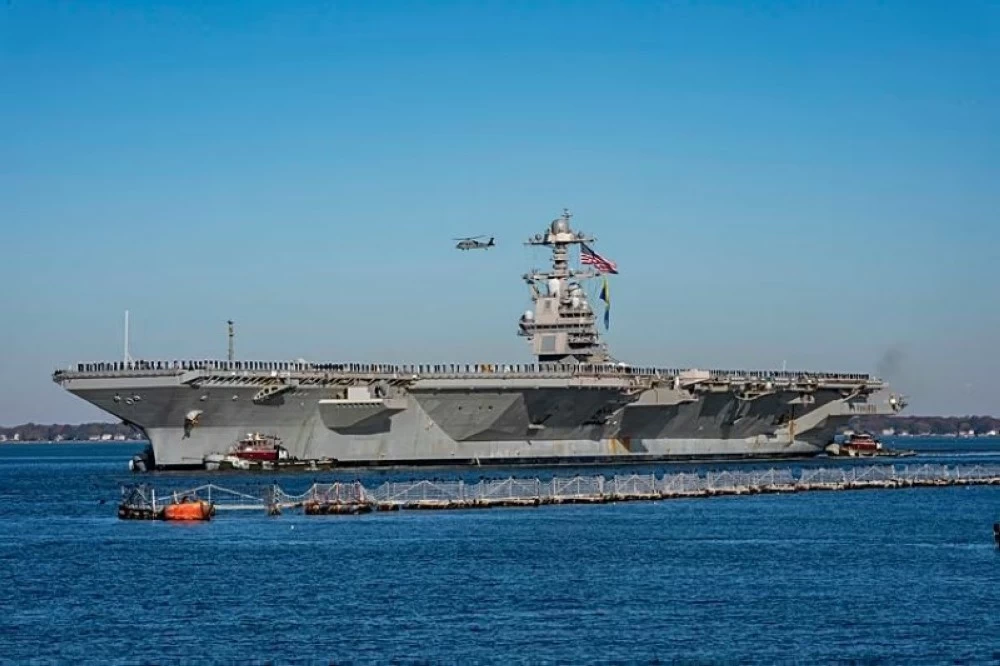
WASHINGTON – The Pentagon plans to send another aircraft carrier to the Middle East to join the aircraft carrier Abraham Lincoln and a guided-missile destroyer already in the region, as President Donald Trump seeks to pressure negotiations over Iran’s nuclear program, U.S. officials announced Friday.
One official, speaking on condition of anonymity, said it would take at least a week for the aircraft carrier USS Gerald R. Ford to reach the Middle East.
The Gerald R. Ford, considered the world’s most powerful and most advanced aircraft carrier, was sent from the Mediterranean to the Caribbean in October as the Trump administration amassed a massive military presence ahead of last month’s operation that led to the capture of Venezuela’s Nicolas Maduro.
News of the deployment came as President Trump warned Tehran on Thursday that failing to reach an agreement with his administration would be “very traumatic.”
Asked about the timeline for reaching an agreement with Iran on its nuclear program, President Trump said, “I think we’ll see something like that within the next month.” “It should happen soon. They should agree soon.”
It has a displacement of 100,000 tons and a length of 334 meters, and although it normally operates with an air wing of 60 to 70 aircraft, it has a flight deck that can accommodate more than 75 aircraft.
The ship is also equipped with an Electromagnetic Aircraft Launch System (EMALS) and can fly up to 160 sorties per day, compared to 120 on older carriers.
Its air wing includes the F/A-18 Super Hornet fighter, the EA-18G Growler electronic warfare aircraft, the E-2D Hawkeye early warning aircraft, and the MH-60 helicopter.
The ship is powered by an A1B nuclear reactor, giving it virtually unlimited range and not requiring refueling throughout its estimated 50-year service life.
The reactor produces enough energy to power a city of 100,000 people. Its defense systems include missile launchers, phalanx artillery, and state-of-the-art anti-missile batteries.
Related articles

SpaceX and NASA bring new crew to space station after medical evacuation in mid-January
The duration of the mission to the Middle East remains unclear, but the mission will likely result in an unusually long period of time away from home port.
The United States most recently carried out an attack on Iran’s nuclear facilities in June last year and stationed two aircraft carriers in the area.
With only 11 aircraft carriers in the U.S. military’s arsenal, carriers are a scarce resource, and their schedules are typically set far in advance.
U.S. Southern Command, which oversees U.S. military operations in Latin America, said in a statement that it remains focused on countering “illegal activity and malign actors in the Western Hemisphere.”
President Trump said this week that he is considering sending a second aircraft carrier to the Middle East if a deal is not reached with Iran.
President Trump spoke with Israeli Prime Minister Benjamin Netanyahu on Wednesday and told the Israeli leader that negotiations with Iran must continue.
Prime Minister Netanyahu has called on the Trump administration to require Iran to scale back its ballistic missile program and end support for extremist groups acting on its behalf, such as Hamas and Hezbollah, as a component of any deal.
If hostilities resume, Iran would most likely use its missile arsenal to target Israeli and US military bases in the region, but it could also attack oil infrastructure and mine the Strait of Hormuz, where about a fifth of the world’s oil is transported.
Tehran’s military includes about 600,000 regular troops and 200,000 members of the Islamic Revolutionary Guard Corps (IRGC) paramilitary group.
Iran’s air force is also considered below average, with its older F-14 and MiG-29 fighters outclassed by the US’s F-35 fifth-generation stealth fighter and Israeli aircraft. — Agency
