


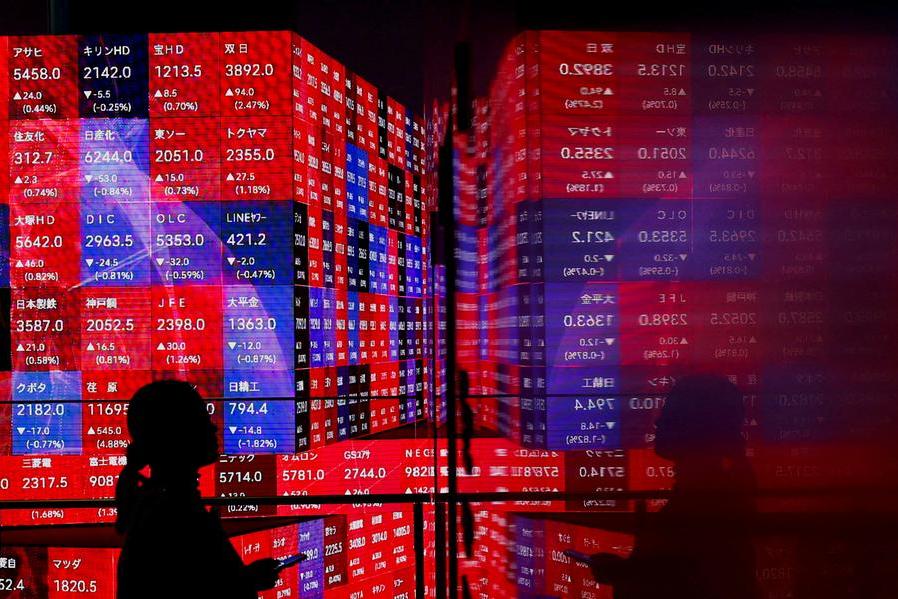
LONDON/SINGAPORE – Global stocks hit an all-time high on Thursday as fears over AI disruption continue to fade, while Japan’s yen regained its footing after its latest collapse and gold rose ahead of U.S.-Iran talks.
Back in the tech world after Nvidia’s overnight results, Japan’s Nikkei Stock Average and South Korea’s KOSPI hit record highs in Asia, but Europe’s reopening was more muted following mixed news in Europe.
Shares in London Stock Exchange Group soared more than 5% after announcing a $4.1 billion share buyback plan, while shares in Belgian chemical maker Syensqo plunged nearly 22% after the company announced disappointing results.
Traders were still digesting Nvidia’s numbers after the world’s most valuable company announced a staggering $78 billion first-quarter revenue outlook, betting on Big Tech’s unabated spending on AI processors.
Initial positive reactions in the U.S. market faded by the end of a lengthy local reaction after the company’s conference call provided limited details on its earnings outlook and quashed talk of cash returns.
Deutsche Bank’s Jim Reed said the reaction was “likely a sign of growing investor anxiety about AI valuations,” especially given that Nvidia had achieved 73% year-over-year revenue growth on a 75% gross margin.
Back in Europe, the British pound was falling towards $1.35 on currency markets as voting began for the vacant parliamentary seat.
acidic test
For Prime Minister Keir Starmer, who is in trouble for this country.
Mr Starmer’s party easily won seats in the recent national election, but a series of recent blowbacks mean it is now in a contest with right-wing populist Nigel Farage’s Reform UK Party and the left-wing Green Party.
“I don’t often meet people who ask if they should buy pounds,” said Société Générale’s Kit Jacks.
“But they (Labour) have a very strong majority and there will be no national election,” he said, adding that the bigger focus was what the UK’s economic growth rate would be.
push and pull
The yen rebounded from recent lows and rose 0.3% following the Bank of Japan governor’s remarks.
Kazuo Ueda
The Bank of Japan’s outlook for short-term interest rate hikes appears to be on hold.
This comes a few days after it was reported that Prime Minister Sanae Takaichi expressed reluctance to raise interest rates further in a meeting with Mr. Ueda. The government has also just appointed two academics who support economic stimulus to the Bank of Japan’s board.
“It’s kind of a push and pull, and the Bank of Japan is walking a very fine line,” said David Chao, global market strategist for Asia Pacific at Invesco.
“However, we still believe the central bank will raise rates twice this year, and the yen is likely to be one of the best performing currencies.”
Japan’s Nikkei average also hit a new high in the Tokyo market and ended slightly higher.
South Korea’s KOSPI soared more than 3%, a move largely driven by semiconductor makers Samsung and SK Hynix, which Deutsche Bank’s Reed pointed out, pushing the KOSPI up just short of 50% this year.
Meanwhile, oil markets seesawed amid concerns about the threat to supplies from a potential military conflict between the United States and Iran.
The two countries will hold the latest round of talks in Geneva on Thursday aimed at resolving their long-standing nuclear dispute and averting a new U.S. attack on Iran after a major military buildup.
Brent crude oil futures rose to $71.20 a barrel in Asia, but fell to $70.40 in London, while U.S. crude fell about 0.5% to $65.09.
Safe-haven gold rose 0.5% to $5,190 an ounce, but remains below a series of record highs reached late last month.
“Sustained tensions between Iran and the US and uncertainty around the global economy due to President Trump’s tariffs are bullish catalysts,” said Carlo Alberto de Casa, an external analyst at banking group Swissquote.
