

BASRA, Iraq: In a greenhouse and sterile laboratory west of Basra, Iraqi technicians wearing gloves and masks lift tiny date palm sprouts from jars, hoping to one day restore orchards ravaged by decades of war, land loss and creeping water salinity.
Date palms, once the center of Iraq’s agricultural economy, have been devastated by the damming of the Tigris and Euphrates rivers, reduced rainfall, saltwater intrusion and decades of conflict.
Driven by the private sector, scientists and authorities are now expanding tissue culture propagation to produce disease-free date palm seedlings and preserve Iraq’s rare varieties.
“Tissue culture agriculture is mainly characterized by high yields,” said Mohamed Abdulrazaq, director of Nakheel Al Basra. “Previous methods yielded three or four branches from a palm tree, but with tissue culture, a single palm can produce thousands of branches.”
From one palm to thousands
Nakheel Al Basra, one of the largest tissue culture laboratories in the province, will start operations in 2023 and will be able to produce up to 250,000 palm seedlings per year, Abdulrazaq said, adding that the success rate of tissue culture palms is up to 99%.
Inside the laboratory, workers use masks and gloves when handling palm samples to minimize contamination. The small buds are stored in jars on racks and passed through stages designed to produce uniform, disease-free planting material.
Abdulrazaq said war, bulldozing of farmland and rising water salinity were pushing some of Iraq’s date palm varieties to the “endangerment of extinction”.
Iraq’s water security has become a pressing issue as water levels on the Euphrates and Tigris rivers have fallen rapidly, exacerbated by dams upstream, mainly in Turkey.
In Shatt Al Arab, this decline is pushing seawater from the Gulf further inland, increasing salinity to unprecedented levels, which farmers describe as a “tongue of salinity” in the water supply.
Dr. Jassim Mohammed, director of agriculture at the Basra Agriculture Directorate, said there used to be 13 million palm trees in Basra alone, out of a total of 32 million in Iraq, but that number has since plummeted.
Reinforced to withstand heat and salt
Researchers at the facility say producing seedlings is only part of the challenge in Basra, where summer temperatures can exceed 50 degrees Celsius (122 degrees Fahrenheit) and increase salinity in the water.
Ismail Sadiq, a researcher at Nakheel Al Basra, said young palm trees are acclimatized to extreme conditions by gradually increasing temperatures before planting to increase their chances of survival.
The process begins at 25 degrees Celsius (77 degrees Fahrenheit) and gradually increases to about 52 degrees Celsius (126 degrees Fahrenheit), a temperature that can be reached even in summer in Basra, he said.
“So if you move to a place with a similar or higher temperature, the palm will fully adapt,” Sadiq says.
He said the salt concentration in the lab was also gradually increased from no salt to 6,000 to 8,000 ppm to prepare the plants to tolerate salt water in the field.
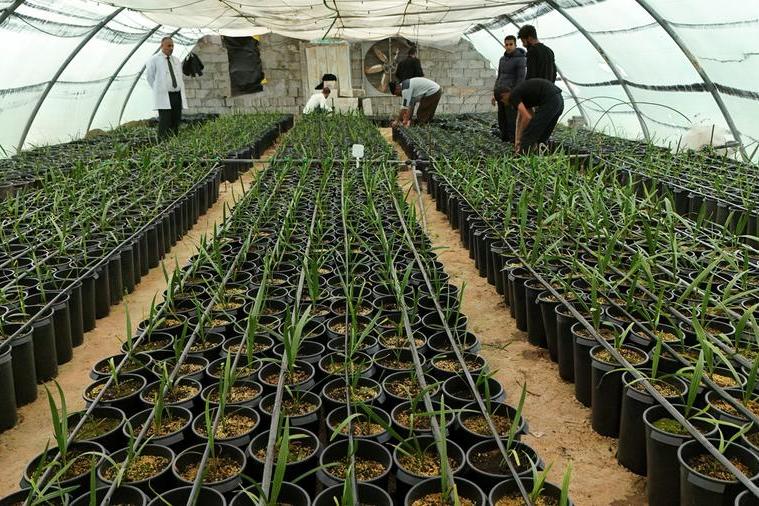
Standing in a greenhouse lined with young palm trees and irrigation lines, Abdulrazaq said the process has entered a post-experimental phase.
“The palm trees are now ready to be sold to farmers, but it will take six months to plant them in the ground,” he said. “It’s also prepared for outdoor environments.”
Some farmers say the technology is already improving survival rates. Farmer Faisal Al Khazraj said he planted 100 tissue culture seedlings alongside 100 conventional branches.
“All 100 tissue culture palms were successful, but the other 100…to be honest, we only got 25,” he said.
Abdulrazaq said the institute breeds Iraqi varieties such as Barhi, while also introducing imported commercial varieties such as Sukari. Seedlings, which are about 30 centimeters tall, sell locally for $40 to $60, he added.
Tissue culture palms now account for more than 15% of the varieties in Basra’s Al Zubair and Safwan districts, said Saleh Hassan, head of agriculture in Basra’s Al Zubair district.
Dr. Mohammed said Basra has added about 600,000 palm trees over the past five years, bringing the total to about 3 million. According to him, more than 100,000 of these are tissue-cultured palm trees. (Writing: Inas Alashley; Editing: Michael Perry)
