


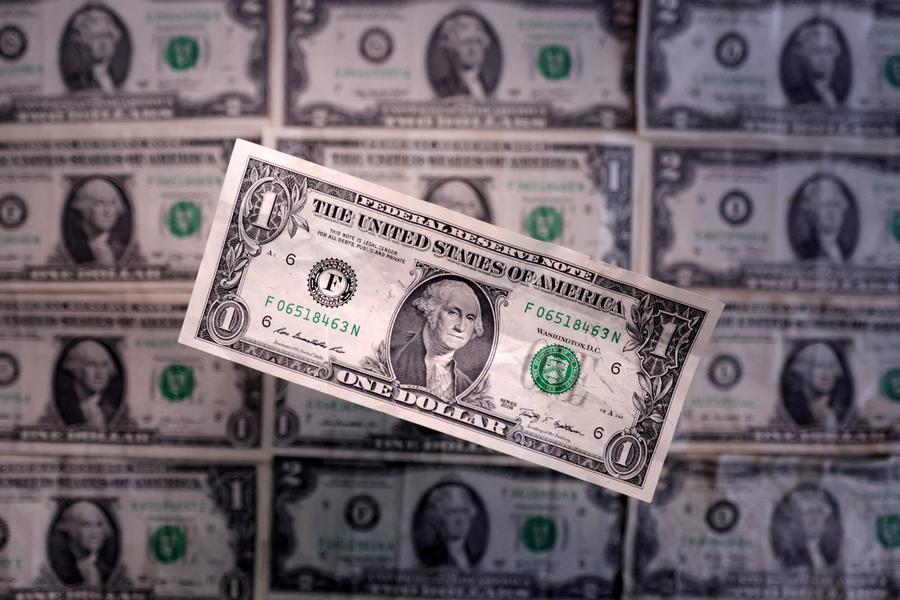
LONDON – The dollar was largely steady on Tuesday as strong economic data and changing expectations for Federal Reserve policy outweighed concerns about another U.S. government shutdown.
The dollar index, which measures the greenback against a basket of currencies, was little changed at 97.53, after gaining 1.5% in two days. The euro rose 0.12% to $1.1804.
The dollar has been firming in recent days following Kevin Warsh’s nomination as the next Fed governor, as markets expect him to be less likely to seek rapid interest rate cuts than other candidates.
Fed rate cuts still expected
Lee Herdman, senior currency analyst at MUFG, said Warsh’s nomination also shows that President Donald Trump is not trying to usurp the Fed’s power over policy-making. But Warsh is also likely to “support lower interest rates, at least initially,” he noted.
“We think the dollar will fall again once the problems subside, and we expect the Fed to cut rates and the ECB to keep rates on hold, which will bring the euro-dollar back above the 1.20 level by the end of the year.”
Meanwhile, U.S. manufacturing data showed a return to growth, with the Institute for Supply Management announcing on Monday that the manufacturing PMI had rebounded to 52.6 last month, the highest reading since August 2022.
However, the much-watched US employment statistics for January will not be released this week due to the partial shutdown of the federal government.
Elsewhere in the region, geopolitical tensions eased after the US announced it would reach a trade deal with India and resume nuclear negotiations with Iran.
A sharp rise in the Australian dollar
The Australian dollar soared after the Reserve Bank of Australia raised interest rates for the first time in two years, raising the cash rate by 25 basis points to 3.85%. The central bank also warned about inflation, raising the prospect of at least one more interest rate hike this year.
The Australian dollar was last up 0.96% to US$0.7014. Against the yen, it rose more than 1.5% to 109.48 yen, the highest since 1990.
The European Central Bank and Bank of England are expected to keep interest rates on hold at their meetings on Thursday. Markets will be watching closely for any hints from the ECB as to whether the euro’s recent strength may influence future policy decisions.
Later in the week, the focus will be on Japan’s lower house elections.
Investors have been selling the yen and Japanese government bonds ahead of the Feb. 8 general election, betting that a strong performance by Prime Minister Sanae Takaichi’s party will give them latitude to expand stimulus.
The yen took a breather last week after Japanese policymakers signaled they would engage in coordinated action with the United States to defend the currency.
The dollar was last stable against the Japanese currency at 155.67 yen, down from a 1-1/2-year high of 159.45 yen in mid-January.
“The outcome of this weekend’s election will be key, as Mr. Takaichi’s strong performance could push the yen back towards the 160 yen level,” said Matthew Ryan, head of market strategy at Everly.
Finance Minister Satsuki Katayama on Tuesday defended Prime Minister Takaichi’s recent comments emphasizing the benefits of a weaker yen, saying the prime minister was referring to “what is written in textbooks.”
Among cryptocurrencies, Bitcoin fell 0.3% to $78,211.25, and Ether fell 2.5% to $2,281.98. (
