


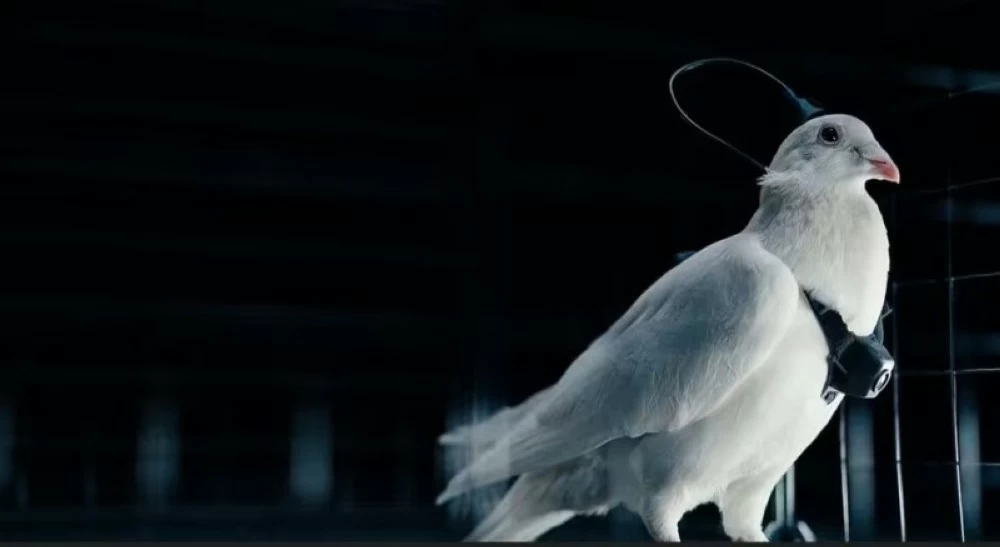
Media reports have revealed a controversial Russian technology project. The project aims to develop electronic chips that can be implanted in the brains of birds, especially pigeons, and used for surveillance and espionage, which could mark a qualitative change in unconventional reconnaissance methods.
bird brain nerve slice
The project, codenamed PJN-1, is being developed by a Russian technology start-up with significant support from the Kremlin, according to the Express website. The birds have neural chips implanted in their brains and small cameras attached to their bodies in units that resemble small “backpacks.”
The company says the technology allows operators to direct the bird’s flight path as needed by gently stimulating specific areas of the brain, causing the bird to prefer a particular direction without affecting its natural behavior. The birds continue to fly normally, but the system’s role is limited to guiding them along a predetermined path.
Bathroom with control unit
Neiry Group has indicated that initial tests included cameras similar to those used in public surveillance systems, as well as bathrooms equipped with small control units and solar panels mounted on the back.
She confirmed that in accordance with local privacy laws, all images taken are processed directly on the device itself, and any personally identifying details are excluded.
The company is promoting the project as an effective alternative to traditional drones, explaining that the biological vehicle does not require batteries or frequent landings, and the nature of its flight allows it to cover distances of up to 400 kilometers per day without stopping, making it suitable for long-range missions.
She added that the goal of the project is to use living objects in environments where drones face limitations related to range, weight, or stealth capabilities.
Future plans for using crow
In this regard, the company’s CEO Alexander Panov said that while the current technology works for pigeons, “any species of bird can be used as a carrier,” pointing to future plans to use crows to carry larger loads, seagulls to monitor coastal facilities, and albatrosses for surveillance missions over large ocean areas.
The company is currently evaluating potential civilian applications for the technology, including infrastructure inspections, supporting search and rescue operations, coastal and environmental monitoring, and monitoring remote areas, but the project’s links to the military have raised widespread concerns.
Support from the Kremlin
Neyri Group reportedly receives significant funding from the Kremlin, estimated at around £10 million, much of it provided through the National Technology Initiative, a program launched by Russian President Vladimir Putin in 2014 to promote Russia’s leadership in the high-tech sector.
Panov is known to publicly support Russia’s war in Ukraine and has previously called for new ways to give Russian forces a military advantage in a battlefield dominated by drones. He has previously caused controversy with comments he made about his ambition to develop a superior human species called Homo superior, a vision many people fear.
Media reports have revealed a controversial Russian technology project aimed at developing electronic chips to be implanted in the brains of birds, particularly pigeons, and used for surveillance and espionage, which could represent a qualitative leap forward in unconventional reconnaissance methods.
bird brain neural chip
The project, codenamed PJN-1, is being developed by a Russian technology startup that has received significant support from the Kremlin, according to the Express website. The birds have neural chips embedded in their brains, as well as small cameras mounted inside a unit that resembles a small “backpack.”
According to the company, the technology allows operators to direct the bird’s flight path as needed through optical stimulation of specific areas of the brain, encouraging the bird to prefer a particular direction without affecting its natural behavior. Although the birds continued to fly normally, it became clear that the system’s role was limited to guiding the birds towards a predefined path.
Pigeon equipped with control unit
The Nairi Group indicates that initial tests included pigeons equipped with cameras similar to those used in public surveillance systems, as well as small control units and solar panels attached to their backs.
In accordance with local privacy laws, we have confirmed that all captured images are processed directly on the device itself to exclude any personally identifying details.
The company is promoting the project as an effective alternative to traditional drones, explaining that the biological vehicle does not require batteries or repeated landings, and its flight characteristics make it suitable for long-range missions that can cover distances of up to 400 kilometers daily without stopping.
He added that the project’s goal is to utilize living organisms in environments where drones face limitations such as range, weight and stealth capabilities.
Future plans for using crow
In this context, the company’s CEO Alexander Panov said that although current technology works for pigeons, “any species of bird can be used as a carrier,” pointing to future plans to use crows to carry larger payloads, seagulls for coastal monitoring, and albatrosses for surveillance missions over large ocean areas.
The company is currently evaluating potential civilian applications of the technology, including infrastructure inspections, supporting search and rescue operations, coastal and environmental monitoring, and surveying remote areas. But the project’s ties to the military have raised concerns.
Support from the Kremlin
According to the report, Neyri Group receives significant funding from the Kremlin, estimated at around £10m, with a significant portion of it being provided through national technology initiatives. The National Technology Initiative is a program launched by Russian President Vladimir Putin in 2014 to strengthen Russia’s leadership in advanced technology.
Panov is known to publicly support Russia’s war in Ukraine and has previously called for new ways to give Russian forces an edge on a battlefield increasingly dominated by drones. He has also caused controversy with his comments about his ambition to develop a superior human race called Homo Superior, a futuristic vision that many consider worrying.
