


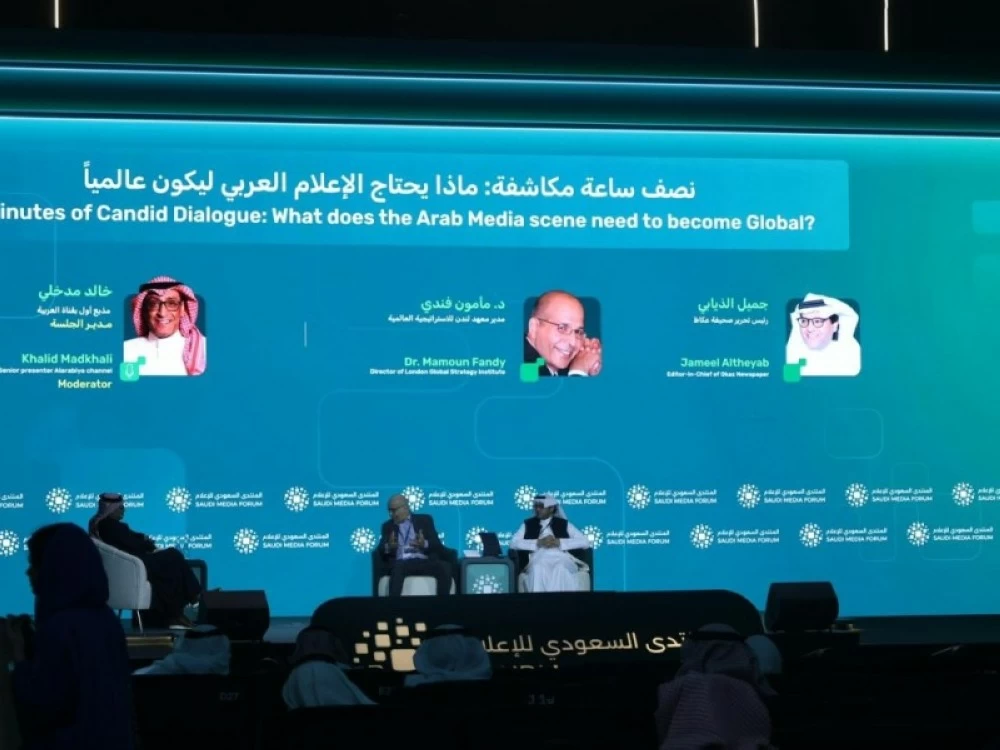
RIYADH — Arab media risks losing regional and global influence if it lacks reliable information or limits its messages to domestic audiences without a broader regional or international perspective, Okaz editor-in-chief Jamil Al Sayyabi said on Tuesday.
Speaking at a panel entitled “What does it take for Arab media to expand globally?” Speaking at the Saudi Media Forum, al-Sayabi said Arab media sometimes operate in an emotional mode rather than through a clear narrative that frames news stories, reports and investigative reporting.
He stressed that the lack of verified information undermines journalism itself. “If there is a lack of information, the news disappears,” he said, pointing to the occasional mistrust between journalists and sources as a major obstacle.
Al Sayabi pointed out that today’s world functions as “one room” and said that translation alone cannot achieve global reach. He argued that to have international influence, you need a fact-based, non-emotional narrative that can persuade a global audience.
He added that reliability and dependability must be prioritized, even at the expense of speed. “Losing the scoop is sometimes the price of maintaining trust,” he said, emphasizing that trust creates deeper and more lasting impact in a rapidly changing world.
Al Sayabi called on Arab media organizations to develop a clear editorial identity and consistent editorial policies based on professionalism and distinctive influence.
Mamoun Fandi, director of the London Institute for Global Strategy, also spoke at the session, saying that Western decision-makers primarily view Arab media through the lens of “stories.”
Related articles
Saudi Arabia and Turkiye sign 5,000MW solar power project development agreement
He noted that while economic issues emanating from influential countries such as Saudi Arabia often receive intense attention, political issues face greater scrutiny and require verification by reliable sources and research institutions to assess the reliability of information coming out of the Arab world.
Fundi said it was a “long and complex process” to overcome the lack of trust between journalists and sources in the region, adding that translating Arab issues into a global narrative required sustained organized efforts rather than short-term influence.
He warned that while the current fascination with artificial intelligence in the media will eventually fade, accurate, verified and well-documented information will have lasting value.
The session, moderated by Al Arabiya presenter Khaled Madkari, examined why Arab media discourse is often confined to regional frameworks and struggles to penetrate global public opinion.
Participants emphasized the need to achieve what they called “narrative sovereignty,” moving from passive recipients of global narratives to active newsmakers who can shape and impose their own narratives internationally.
The discussion also addressed the need to develop media professionals who can communicate with Western audiences using Western language and logic, the impact of global platforms and algorithms that amplify or limit Arab voices, and the tools needed to strengthen the global presence of Arab media.
