

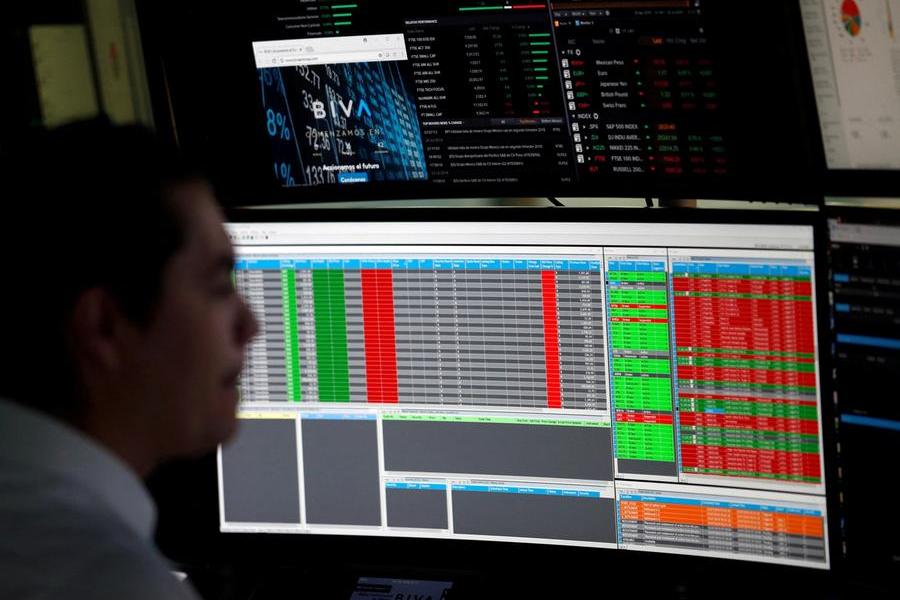
Global stock markets were on track to end a five-session streak of gains on Wednesday, but the U.S. dollar maintained its gains after the Federal Reserve left interest rates unchanged, as most expected. The Fed cited solid economic growth and persistently high inflation in keeping interest rates on hold, and its latest policy statement gave little indication of when borrowing costs would be lowered again.
Investors will now be watching comments from Chairman Jerome Powell, whose term ends in May, for clues on how interest rates will move. U.S. stocks had little reaction to the Fed’s statement, with Apple’s earnings scheduled for Thursday, while the S&P 500 booked a modest loss after rising above 7,000 for the first time, with gains from mega-cap companies Microsoft, Tesla and Meta Platforms set aside after the close.
“The Fed didn’t make a fuss,” said Ryan Detrick, chief market strategist at the Carson Group in Omaha. “The Fed was widely expected to halt policy. The reality is that we probably won’t see a rate cut until Chairman Powell leaves the Fed after May.”
“They made some positive points on the labor market side, but obviously inflation is a concern. Look at the rise in commodity prices that we’ve seen recently.”
The Dow Jones Industrial Average rose 24.74 points, or 0.05%, to 49,028.15, the S&P 500 fell 4.39 points, or 0.06%, to 6,974.21, and the Nasdaq Composite Index rose 28.14 points, or 0.12%, to 23,845.24.
After rising to an intraday high of 1,055.04, MSCI’s global stock index fell 0.73 points (0.07%) to 1,050.35, marking its third consecutive intraday high. The pan-European STOXX 600 index closed 0.75% lower, weighed down by an almost 8% decline in LVMH after the owners of Louis Vuitton and Tiffany & Co. reported quarterly results, but CEO Bernard Arnault said he was cautious about the year ahead.
FX watch
The dollar showed signs of stabilizing after posting its biggest single-day decline since Aug. 1, as U.S. President Donald Trump on Tuesday appeared to erase recent dollar weakness and push the greenback to a four-year low.
The dollar has weakened recently due to expectations that the Federal Reserve will continue to cut interest rates this year, tariff uncertainty, policy instability including threats to central bank independence, and rising budget deficits, all of which are reducing investor confidence in the stability of the U.S. economy.
The dollar index, which measures the dollar against a basket of currencies, rose 0.79% to 96.66, while the euro fell 1.07% to $1.1911, after breaking above the $1.20 mark following President Trump’s remarks. European Central Bank policymakers have warned of growing concerns over the euro’s rapid appreciation against the dollar, which could push down inflation even though price increases are already below the ECB’s 2% target.
The Fed meeting comes as the Trump administration continues its criminal investigation into Mr. Powell, makes progress in its efforts to remove Fed Director Lisa Cook, and appoints a new director. According to CME’s FedWatch tool, the market has not priced in more than a 50% chance of a rate cut until the central bank’s June meeting.
Against the Japanese yen, the dollar rose 1.08% to $153.84, while the pound fell 0.56% to $1.3768. U.S. Treasury Secretary Scott Bessent said the U.S. has a strong dollar policy, which means setting the right fundamentals, and denied that the U.S. was intervening in foreign exchange markets to support the yen after the Japanese currency soared against the dollar last week.
The recent weakness in the dollar has provided support to other commodities, helping gold hit a record high of more than $5,300 an ounce. us. Oil prices rose 1.07% to $63.07 per barrel, while Brent crude oil rose 1.04% on the day to $68.27 per barrel, after hitting a four-month high of $68.53.
(Reporting by Chuck Mikolajczak; Additional reporting by Pranav Kashyap and Twesha Dikshit in Bengaluru; Dhara Ranasinghe in London; Tom Westbrook in Singapore; Editing by Timothy Heritage, Jan Harvey, Alexander Smith and Rod Nickel)
