


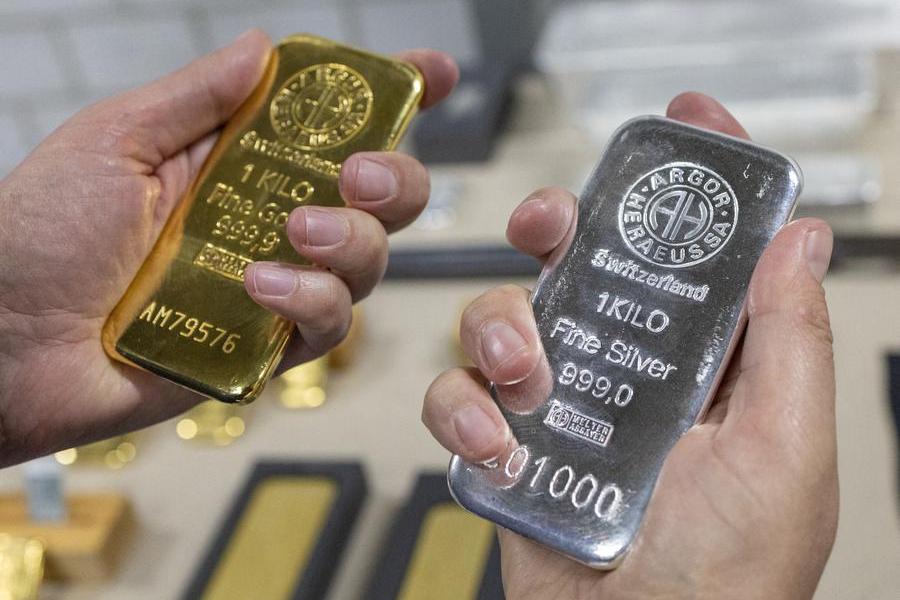
Commodities markets fell on Monday, led by sharp declines in gold, silver, oil and industrial metals, while precious metals fell for a second session on a selloff sparked by President Donald Trump’s selection of Kevin Warsh to be the next US Federal Reserve chairman.
Gold and silver rose 30% and 71% to record highs in January before starting to decline.
Losses spilled over into the stock market as investors dumped other assets to cover losses in precious metals. Global stocks fell for a third day in a row, led by sharp declines across Asia and Europe, with basic resources stocks under heavy attack.
MSCI’s global index fell 0.5% on the day and has fallen 1.5% since its all-time high on January 27th.
Investor nervousness is reflected in a resurgence in the VIX volatility index, which is approaching the 20 level, which many see as a sign of growing market tension.
Gold fell 5% to its lowest in more than two weeks, while silver fell more than 7%.
Oil fell nearly 5%, off a multi-month high, and copper on the London Metal Exchange fell 3%.
On Friday, President Trump nominated Warsh, a former Federal Reserve official, to replace central bank chief Jerome Powell in May. This choice triggered a sell-off across financial markets.
Wall Street opened lower on Monday. As of 1430 GMT, the Dow Jones Industrial Average was down 0.14%, the S&P 500 was down 0.22% and the Nasdaq Composite was down 0.4%.
Trump’s choice of Warsh overturns the idea that Powell’s successor would push for aggressive monetary easing and boost the dollar, which would make goods more expensive for holders of other currencies and hurt demand.
Mr. Warsh currently advocates lower interest rates, but before his time at the Fed he had a reputation as an inflation hawk.
“The market’s decision to sell precious metals alongside US equities suggests that investors view Mr. Warsh as more hawkish,” said Vivek Dhar, commodity strategist at Commonwealth Bank of Australia.
A hawkish Fed has signaled that interest rates will remain high for an extended period of time, supporting the dollar and raising the opportunity cost of owning gold and silver, making them less attractive.
But Dahl added, “A stronger US dollar is also putting pressure on precious metals and other commodities, including oil and base metals,” leaving his fourth-quarter gold price forecast unchanged at $6,000.
Selling of precious metals accelerates due to rising profit margins
The decline began on Friday, with spot gold falling more than 9%, its biggest single-day decline since 1983, while silver fell 27%, its biggest single-day drop on record.
The sell-off in precious metals accelerated as CME Group raised margins on metal futures in the wake of Monday’s market close.
Increases in margin requirements are generally negative for affected contracts, as increased capital expenditures reduce speculative participation, reduce liquidity, and potentially cause traders to exit positions.
“The scale of the unwinding that is occurring in the gold market today is unlike anything I have seen since the dark days of the global financial crisis in 2008,” said IG market analyst Tony Sycamore.
Meanwhile, energy market prices came under pressure on Monday from signs of easing tensions between the U.S. and Iran, as fears of a conflict with the OPEC member eased following President Trump’s comments over the weekend that Iran was in “serious talks” with the United States.
These comments, along with reports that Iran’s Revolutionary Guards Navy is not planning live-fire exercises in the Strait of Hormuz, are a sign of détente, Sycamore added.
In China, the world’s biggest buyer of industrial and bulk metals, copper and iron ore markets faced headwinds ahead of this month’s Lunar New Year holiday on concerns about high inventories and weak demand.
Analysts say end-user demand and transactions are expected to be weak before the holidays begin on February 15.
In other commodities, Tokyo Rubber fell nearly 3%, and Chicago wheat and soybeans fell about 1%.
“The key question is whether this is the beginning of a structural downturn in commodity prices or just a correction,” CBA’s Dahl said.
“We see this as a correction and buying opportunity rather than a fundamental change.”
(Reporting by Naveen Thukral and Pratima Desai; Additional reporting by Ankur Banerjee and Amanda Cooper; Editing by Clarence Fernandez and Joe Bavier)
