

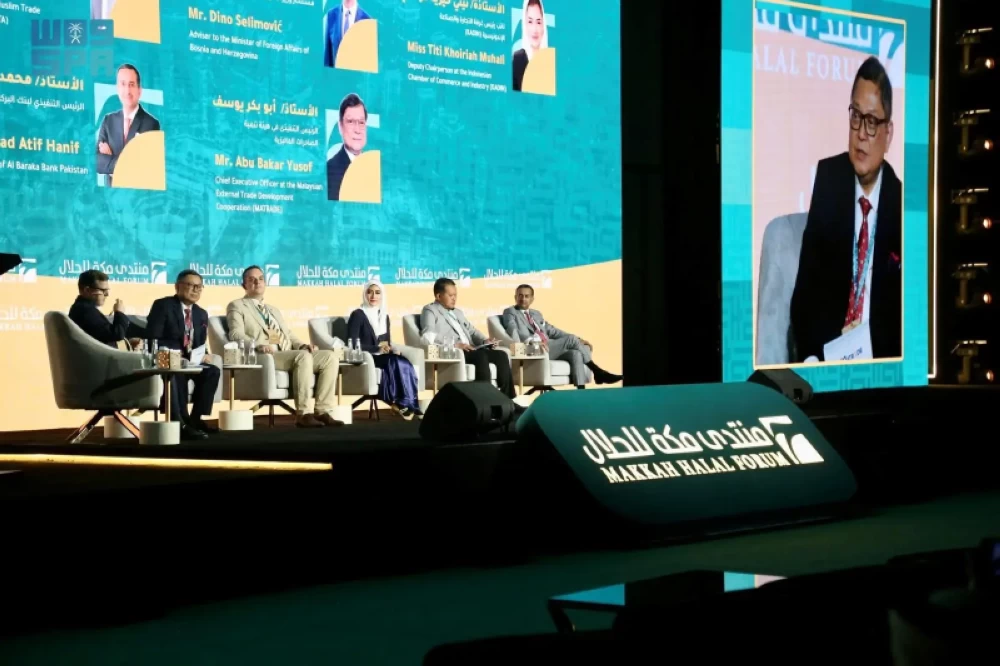
MAKKAH — International experts and experts participating in the third edition of the Makkah Halal Forum 2026 said that the halal sector is undergoing a qualitative economic transformation, moving beyond basic Sharia compliance and moving towards building a fully integrated specialized industry capable of competing in the global market.
At the forum, organized by the Mecca Chamber of Commerce and Industry’s Manafair Initiative, speakers emphasized that the challenge is no longer limited to proving the legitimacy of products. Rather, it is increasingly linked to the development of a professional identity that can permeate global supply chains in a competitive environment driven by operational excellence, trusted brand building, quality, sustainability and efficiency.
In a session titled “Halal as a Global Professional Identity,” Youssef Qarawi, Secretary General of the Islamic Chamber of Commerce, urged domestic and Islamic businesses to realistically assess changes in the global market.
He said competition is no longer limited to Islamic countries, with major international brands also participating.
Karawi pointed out that companies in Europe and the United States have allocated dedicated halal production lines and have successfully entered lucrative seasonal sectors such as Ramadan gifts and modest fashion. He said advanced supply chains and flexible logistics systems provide a clear competitive advantage, adding that producers in the Islamic world need to adopt an integrated industrial model to maintain and expand their market share.
He also emphasized the need to rebuild public perception of the halal sector through a more mature communication strategy.
Halal standards in terms of product safety, raw material transparency and environmental friendliness are directly aligned with global sustainability requirements that are increasingly influencing consumer behavior, he said.
Related articles

DP World CEO Sultan Ahmed bin Sulayem resigns following Epstein email revelations
Karawi pointed out that for some products, despite the quality of the ingredients, there are gaps in packaging and brand presentation.
He said the global experience of Islamic banking provides a successful example of transforming Islamic law-based products into a structured global industry with an institutional presence.
In another session entitled “Building a Halal Brand as a Tool for Global Positioning”, speakers explained that trust is the basis of brand building, pointing out that quality combined with ethical values is decisive in attracting consumers, especially in the fast-growing modest fashion sector.
Discussions on brand sustainability focused on how to build global brands that reflect user experiences across diverse markets. It was emphasized that understanding cultural differences is important for expanding internationally without losing a brand’s identity.
The speakers concluded that the halal industry is still in a growth phase and its future depends on systematic investments in human capital, such as building managerial capacity, developing technical expertise, and strengthening marketing and innovation capabilities.
They said the Islamic world’s demographic advantage, characterized by a young population, represents a major strategic opportunity if channeled into building competitive, value-driven industries.
Global ethical and environmental challenges have further reinforced the need for business models based on transparency, human protection and environmental responsibility, principles deeply rooted in the Halal philosophy.
Mecca Halal Forum 2026 will serve as a platform to integrate economic thought, regulatory frameworks, institutional empowerment and technological innovation. The forum aims to strengthen Saudi Arabia’s position as a major player in the global halal economy and leverage Mecca’s spiritual status to build its centrality in the international economy.
