

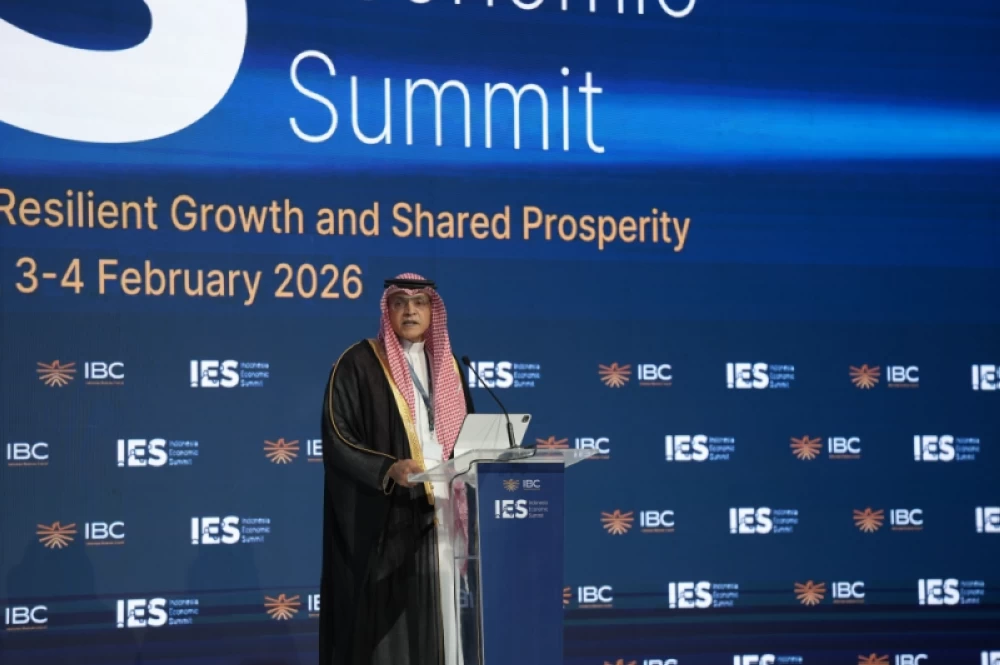
JAKARTA – Abdullah Saleh Kamel, President of the Islamic Chamber of Commerce and Industry and President of the Federation of Saudi Chambers of Commerce and Industry, has warned that the modern global economy faces a serious structural ethical crisis, calling for a new economic model that puts values at the center of decision-making.
Speaking at the opening session of the 2026 Indonesia Economic Summit, Kamel said the world is at a critical economic and moral crossroads, with accelerating geopolitical and economic changes exposing growing cracks in the world system at the expense of societies and individuals.
He said the current global economic order is witnessing a steady erosion of safeguards, with narrow interests and power politics increasingly outweighing human, social and development values.
Kamel argued that recent global transformations have revealed the weaknesses of economic models that fail to deliver sustainable development and the fair distribution of opportunities, largely due to the separation of economic policies from core ethical principles.
“The prevailing economic discourse is no longer reassuring to society,” he said, adding that it reflects a harsher reality that focuses on profit maximization while ignoring people, communities and the environment.
He stressed that business leaders in the Global South and developing countries have a high responsibility to play an active role in shaping alternative models based on rights and responsibilities, rather than short-term profit-loss calculations.
Related articles
328 female security guards hired from Saudi Ministry of Interior graduates
Kamel said economic sustainability cannot be achieved without clear ethical standards, stressing that investment, trade and finance should serve as tools to serve society, rather than undermine environmental integrity and social trust.
He emphasized the rich ethical heritage of the Islamic world, noting that it has historically contributed to advanced economic and humanitarian models, and said there is still an opportunity to reclaim this role and actively participate in shaping the future of the world economy before further instability sets in.
Mr. Kamel also pointed to the vital role of the private sector, saying that with sufficient political will, a supportive regulatory framework and strong institutions that can translate vision into action, the private sector has the ability to work with governments to lead the development pathway.
Citing Saudi Arabia’s economic reforms as an example, he said Vision 2030 provided a practical model for redefining the relationship between the state and the economy and empowering the private sector as a development partner through legal reform, infrastructure investment and digital transformation.
He concluded that the 2026 Indonesia Economic Summit comes at a sensitive time globally, underscoring the importance of dialogue platforms that bring together policymakers, the private sector and think tanks to rethink growth models, strengthen cross-border partnerships and align public policies with market realities.
