

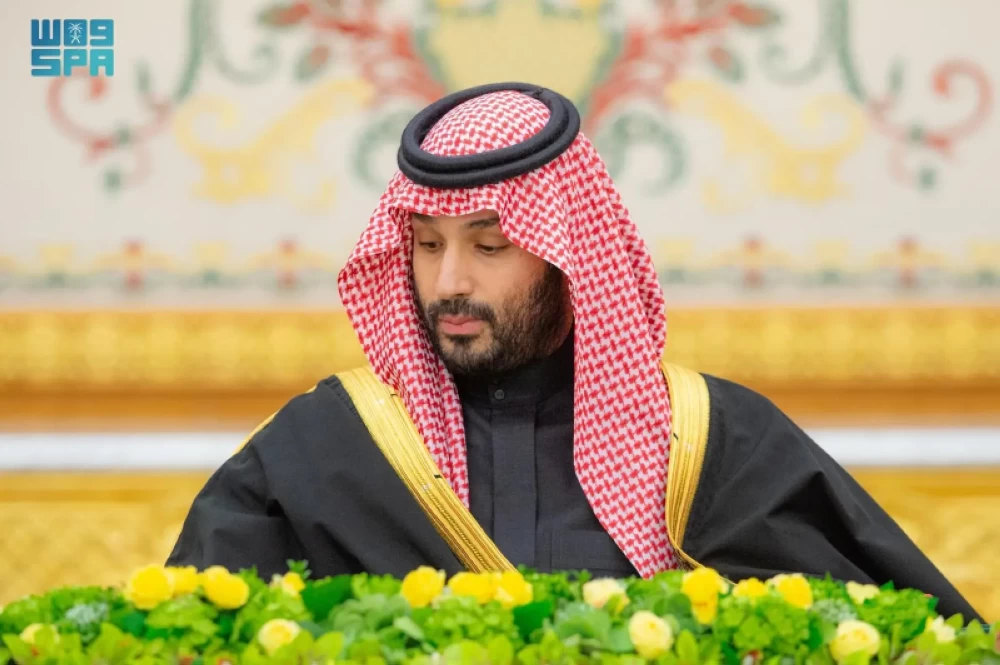
RIYADH — The Council of Ministers reaffirmed Saudi Arabia’s firm positions on current regional and international issues and support for efforts to resolve conflicts through dialogue to strengthen regional and global security and stability. The Crown Prince and Prime Minister Mohammed bin Salman chaired a cabinet meeting in Riyadh on Tuesday.
In a statement to the Saudi Press Agency after the meeting, Media Minister Salman Al Dosari said the Cabinet reviewed recent discussions and consultations between Saudi Arabia and several friendly countries on the latest regional and international developments.
The Cabinet emphasized the content of statements made by the foreign ministers of Saudi Arabia, Arab and Islamic countries condemning the violation of the ceasefire in Gaza by Israeli occupation forces. “These violations undermine international efforts to advance the implementation of the second phase of the peace plan, which aims to consolidate the ceasefire, establish stability, and ultimately achieve a just, comprehensive and lasting peace that will enable the Palestinian people to establish an independent state,” the Cabinet noted.
Al-Dosari said the cabinet praised the response of the Syrian government and the Syrian Democratic Forces, which reached a ceasefire agreement with the support of Saudi Arabia and the United States. The agreement is expected to contribute to Syria’s progress towards peace, security and stability, realizing the aspirations of its people and strengthening national unity.
The Cabinet discussed the outcomes of Saudi-sponsored meetings and conferences and appreciated the active international participation in the 2nd Green Middle East Initiative Ministerial Council Meeting. The meeting also included the approval of new members, bringing the total number of countries participating in the initiative to 35.
Additionally, the conference adopted foundational measures paving the way for the operational and development phase, along with new commitments to achieve the initiative’s goals, including planting more than 22 billion trees and restoring 92 million hectares, to address regional environmental challenges and strengthen global efforts.
The Cabinet praised the achievements of the International Conference on Capacity Building in Data and AI held in Riyadh, noting the launch of numerous initiatives and the signing of 27 agreements across various sectors. These agreements were aimed at strengthening international academic partnerships for knowledge transfer, technology localization, and achieving national strategic goals in this field.
The Cabinet praised the achievements of the 5th Real Estate Future Forum, which witnessed widespread international participation and resulted in the signing of 80 agreements and memorandums of understanding. These are expected to strengthen the developmental role of the real estate sector and contribute to achieving national goals.
The Cabinet welcomed the Saudi Media Forum held under the patronage of King Salman, Custodian of the Two Holy Mosques. The forum witnessed the launch of strategic agreements and initiatives that reflect the advancement of the media sector in the Kingdom and its role in keeping pace with digital transformation and content development, reinforcing Riyadh’s position as a hub for innovators and a world-leading event.
Cabinet reviewed achievements across a number of government sector ecosystems. This report examined the launch of a national privatization strategy, a key enabler of economic diversification and an important means of strengthening the central role of the private sector in integrated development. The strategy is expected to create new prospects, advance infrastructure development, improve the quality of public services, and further enhance Saudi Arabia’s investment attractiveness.
The Cabinet also praised the developmental and qualitative projects launched in the industrial cities of Mecca and Jeddah. These projects aim to support the localization of priority industries, develop local content and promote business operations, thereby contributing to regional economic development.
The Cabinet approved the National Arabic Language Policy in Saudi Arabia. Approved the draft General Cooperation Agreement between the Governments of Saudi Arabia and Cyprus. The Cabinet has authorized the Minister of Culture and the President of the World Academy of Arabic Language King Salman or his representative to consult with the Secretary-General of the Arab League and sign a draft Memorandum of Understanding (MoU) in the field of Arabic language services.
Related articles
Yemen’s Socotra Hospital is fully funded by Saudi Arabia
The Cabinet approved a draft memorandum of understanding between the Saudi Ministry of Justice and the Institute for the Unification of International Private Law, and another memorandum of understanding on cooperation in the postal sector between the Saudi Ministry of Transport and Logistics Services and the Brazilian Ministry of Communications.
The Council authorized the Minister of Economy and Planning or his representative to sign a draft agreement on building a research ecosystem in Saudi Arabia and a draft agreement between the Saudi Ministry of Economy and Planning and Harvard University in the United States to achieve new horizons for Saudi Arabia’s competitiveness and its global impact.
The Cabinet approved a draft agreement between the governments of Saudi Arabia and Finland in the field of air transport services and approved the equestrian authorities’ membership in the International Federation of Thoroughbred Breeders.
The Council approved a draft cooperation agreement between the Saudi National Security Agency and the National Security Agency of Uzbekistan in the field of combating terrorism and its financing, and two draft memorandums of understanding between the Saudi Comptroller General and the Korean Comptroller General’s Office and the Supreme Comptroller General of the United Mexican States for cooperation in the field of accounting, auditing and professional services.
The Cabinet approved the implementation of two resolutions of the 44th Supreme Council of the Gulf Cooperation Council held in Doha. This resolution concerns the adoption of the Uniform Guidance Law as the guiding framework for combating narcotics and psychotropic substances in the GCC countries and the adoption of the Uniform Guidance Law as the guiding framework for on-site response procedures for hazardous materials incidents in the GCC countries.
