

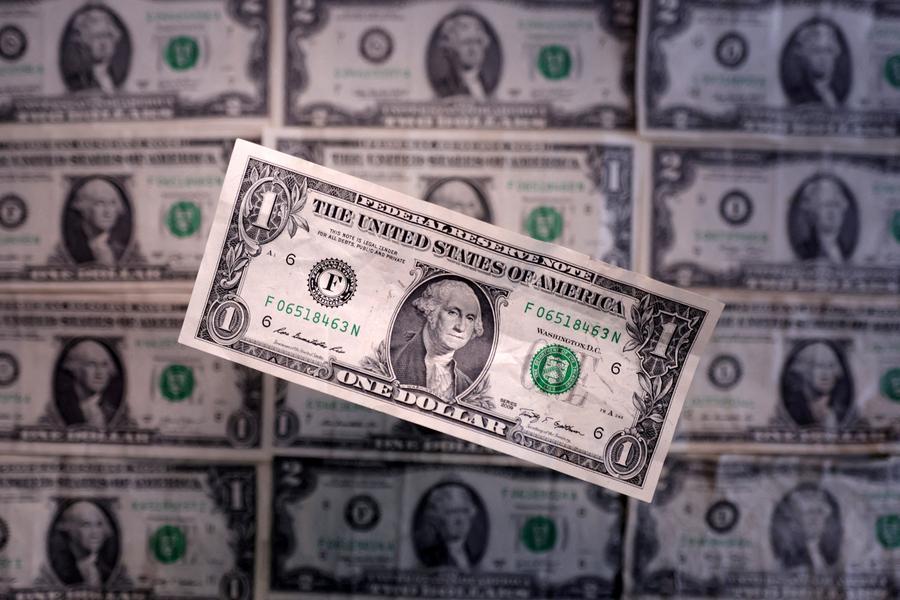
LONDON: The US dollar is once again under fire in the first turbulent weeks of 2026. This is because a variety of factors are increasing, including Washington’s desire for a weaker currency, prompting investors to reconsider their optimistic assumptions about a period of stability for the dollar.
The dollar on Monday was heading for its biggest three-day drop against a basket of major currencies since last April, when President Donald Trump’s “Emancipation Day” tariffs caused a steep decline in U.S. assets.
In his first year in office, Trump’s erratic approach to trade and international diplomacy, attacks on the Federal Reserve’s independence and massive increases in public spending have led to the dollar depreciating by more than 9%, its worst annual level since 2017.
So far this year, the dollar has once again underperformed other major currencies such as the euro, pound and Swiss franc.
whirlwind rate of change
“There are a lot of factors coming together,” said Seema Shah, chief global strategist at Principal Asset Management, which manages more than $600 billion in assets.
“I don’t think this is a ‘sell America’ trade, but the fundamentals are coming together and moving at a faster pace than expected.”
Just this month, President Trump threatened to seize control of Greenland, imposed additional tariffs on European allies over the issue, moved to bring criminal charges against Federal Reserve Chairman Jerome Powell, and oversaw an operation to seize control of Venezuela’s president. On Saturday, it threatened Canada with a de facto trade embargo.
Although he has backed off threats over Greenland and European tariffs and markets have shaken off the Venezuela attack, the backdrop is tense.
While bond market sentiment remains fragile, with market volatility measures remaining elevated and aggressive sales in Japanese government bonds in particular potentially spilling over into government bonds, gold’s relentless streak of new records is a sign that investors are seeking alternative safe-haven assets.
President Trump’s domestic policies, including an aggressive crackdown on illegal immigration that killed two Americans and sparked protests this month, could trigger another government shutdown this month.
“The threat of a government shutdown adds to the tailwinds that have been pushing the dollar down, and adds another reason for those who are reconsidering their U.S. investments or hedging dollar exposure,” said Mark Spindell, chief investment officer at Potomac River Capital in Washington.
Additionally, while other major central banks have paused or are likely to raise rates, the Fed is still expected to cut rates at least twice this year.
This alone could make the dollar less attractive to investors, who may choose to park their money where loan rates are rising.
Mr. Powell resisted pressure from President Trump to accelerate rate cuts and resigned in May. Online betting markets currently believe there is a 50% chance that BlackRock’s head of corporate bonds, Rick Rieder, who like the president is a supporter of low interest rates, will succeed him. That’s up from less than 10% a week ago, adding to the dollar’s weakness.
It’s time to move on
Meanwhile, global stocks soared last year, thanks in large part to the enthusiasm for artificial intelligence. Since President Trump took office, the S&P 500’s performance has lagged the rest of the market. Since then, the index has risen about 15%. By comparison, Seoul’s Kospi index rose 95%, Tokyo’s Nikkei stock average rose 40%, and Shanghai’s main index rose nearly 30%.
“Asset managers are desperate and keen to continue diversifying away from the U.S.,” said Chris Scicluna, an economist at Daiwa Capital Markets. “It’s clear that many asset managers were too focused on the U.S. market, or felt they were too overweight.”
President Trump has repeatedly said tariffs are necessary to address trade imbalances, focusing on the currencies of Asian countries with which the United States has large trade deficits.
On Friday, the Bank of Japan, in cooperation with the New York Fed, is suspected of carrying out a series of interest rate checks on the yen. This could be a harbinger of the first joint U.S.-Japan intervention in 15 years to boost Japan’s currency. The New York Fed acted as the fiscal agent of the United States. According to sources, the Ministry of Finance.
Despite the yen’s subsequent appreciation, Japan’s currency still depreciated by about 13% against the dollar last year.
Trade-weighted dollar exchange rate remains steady
However, on a trade-weighted basis based on an index calculated by the Bank for International Settlements, the dollar has depreciated by only about 5.3% over the past 12 months.
Dominic Banning, head of G10 foreign exchange strategy at Nomura, said investors were becoming increasingly concerned about dollar exposure and attributed last year’s decline to cyclical factors such as slower growth.
“The difference for me[this year]is that the policies that I think the United States is putting in place are much more adversarial and geopolitical as opposed to economic policies with tariffs,” he said.
(Reporting by Amanda Cooper, Samuel Indyk and Darla Lanasinghe; Additional reporting by Suzanne McGee and Gertrude Chavez-Dreyfuss in New York; Editing by Elisa Martinuzzi, Hugh Lawson and Nick Zieminski)
