


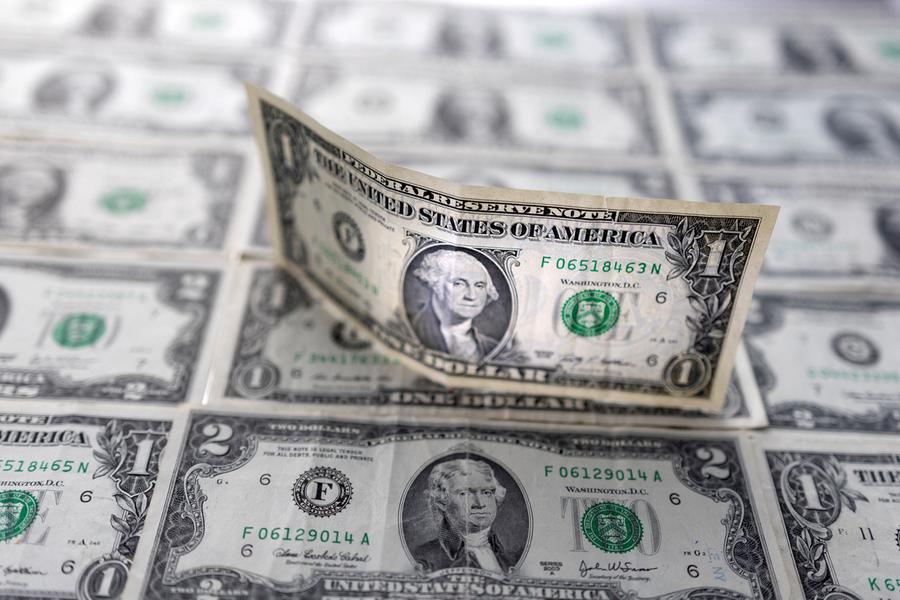
SINGAPORE/LONDON – The dollar rose to a two-week high on Thursday as fresh volatility weighed on stocks and precious metals, as traders anxiously awaited interest rate decisions from the European Central Bank and Bank of England.
The dollar index, which measures the performance of the U.S. currency against a basket of six other currencies, was last up 0.14% to 97.82, rising for the second day in a row.
“We’re seeing some risk aversion,” said Sim Moe Siong, currency strategist at OCBC in Singapore. “The dollar tends to appreciate when there is risk aversion.”
The dollar regained some strength this week and stocks turned risk-off as financial markets took stock of U.S. economic growth. We have reached the midway point of the corporate earnings season.
Gold and silver, which have become more volatile lately as a result of leveraged buying and speculative activity, were rocked by another round of losses on Thursday, with silver falling as much as 16.6% to a low of $73.41.
The Nasdaq Composite Index fell 2.9% over the past two days, its biggest decline since October, with volatility driven by market leaders including Google’s parent company Alphabet, which announced aggressive spending plans on Wednesday, and a decline in software stocks as they adapt to a new era of generative AI.
ECB wins first move
The euro was last down 0.2% to $1.1790 ahead of the ECB’s expected decision to keep interest rates unchanged. Investors’ attention will be focused on the post-policy press conference to determine the outlook for interest rates in the coming months.
For now, the market is indicating that traders think there is little chance of a rate cut this year. Despite the volatility that has dominated markets since the start of the year, the euro is still only around 0.4% stronger than at the time of the ECB’s last meeting in December.
But while the euro is around 13% stronger against the dollar than a year ago, raising some concerns among policymakers about its impact on price pressures in the region, euro zone inflation has fallen to around 1.7%, below the ECB’s 2% target.
MUFG Currency Strategist Lee Hardman said: “We expect the ECB to keep interest rates unchanged until 2026, but given that inflation is likely to be below target, we believe there is a higher risk of further rate cuts than rate hikes.”
Meanwhile, the pound fell 0.5% to $1.358 ahead of the central bank’s policy decision, which is expected to remain unchanged.
Federal Reserve President Lisa Cook said in a speech late Wednesday that she was more concerned about sluggish inflation than a weakened labor market, a strong signal that she would not support further interest rate cuts until price pressures from tariffs begin to recede.
According to CME Group’s FedWatch tool, federal funds futures have an 88% implied probability that the U.S. central bank will keep rates unchanged at its next two-day meeting, which ends on March 18th, although views on a rate cut rose to 12% from 9.4% a day earlier.
The dollar rose 0.14% against the yen on the day, to 157.11 yen. The threat of joint purchases by Japanese and US authorities to counter the yen’s weakness on January 23 pushed the dollar to a three-month low of $152.1. Stocks rose about 3%, recovering about three-quarters of their initial losses as tensions rose ahead of Sunday’s election.
Against the offshore yuan, the dollar ended flat at 6.9439 after a phone call between US President Donald Trump and Chinese President Xi Jinping to discuss trade, security issues and US arms sales to Taiwan.
Cryptocurrencies widened their losses and hit their lowest since November 2024. Bitcoin at one point fell 3.54% to $70,052.48 and last fell 1.7% to $71,720. Ether recovered from an overnight low of $2,068 and stabilized around $2,135.
