

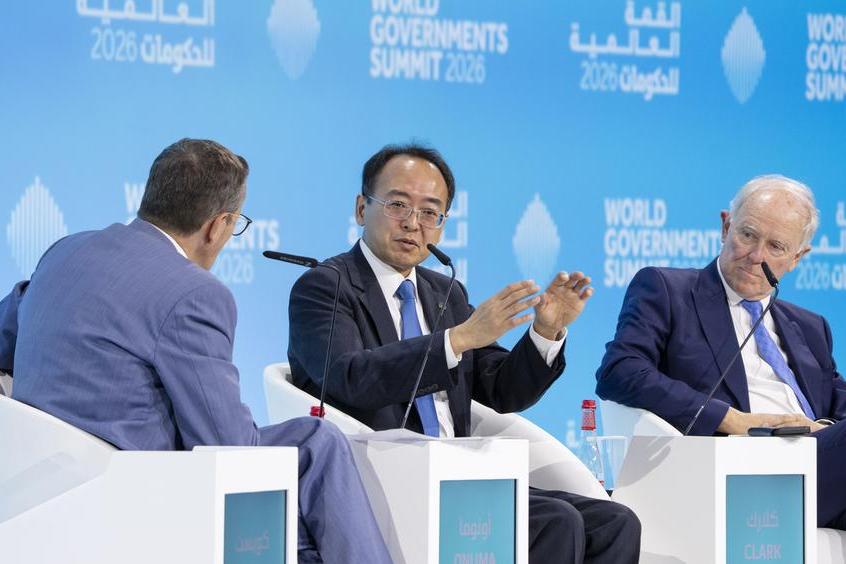
Dubai: Leaders of the global aviation industry, in a high-level panel session on the second day of the 2026 World Government Summit, emphasized the need for faster regulatory alignment, smarter use of technology and stronger international agreements to move aviation forward in an increasingly complex global environment.
The session, titled ‘What’s next for Aviation 2.0?’, was moderated by CNN’s Richard Quest and featured His Excellency Toshiyuki Ohnuma, Chairman of the International Civil Aviation Organization (ICAO), and Sir Tim Clark, President of Emirates Airlines.
Mr. Onuma said ICAO’s primary mission remains to ensure safety, security and sustainability across global aviation, stressing that building consensus among global stakeholders is complex but essential.
“Safety and security are common goals. As long as we focus on these fundamentals, I’m optimistic that we can reach an agreement,” he said.
Regarding sustainability, Mr. Onuma pointed out that aviation regulations will now need to go beyond technical standards to include a long-term environmental framework, adding that prioritizing aviation within broader economic and policy agendas is a key challenge.
Mr Clark praised airspace management in the Middle East, saying regional coordination was a “tough task” that was being handled more effectively than in other parts of the world.
He cited Dubai as a prime example, saying the technology already exists to significantly improve passenger flows, border controls and airport efficiency.
“We can move people around an airport without physical intervention. The technology exists. What we need is the will to deploy it,” he said.
Mr Clark emphasized ICAO’s important role in providing a global regulatory framework, while acknowledging that progress could be slowed by the need for unanimity among countries.
“While consensus is difficult to achieve in today’s world, ICAO provides a common foundation that allows aviation to function safely and efficiently around the world,” he said.
Discussions also addressed emerging challenges such as commercial space launches, airspace congestion, and outdated regulations. Onuma said ICAO is working with member states to identify outdated rules and modernize the framework to suit industry needs.
