

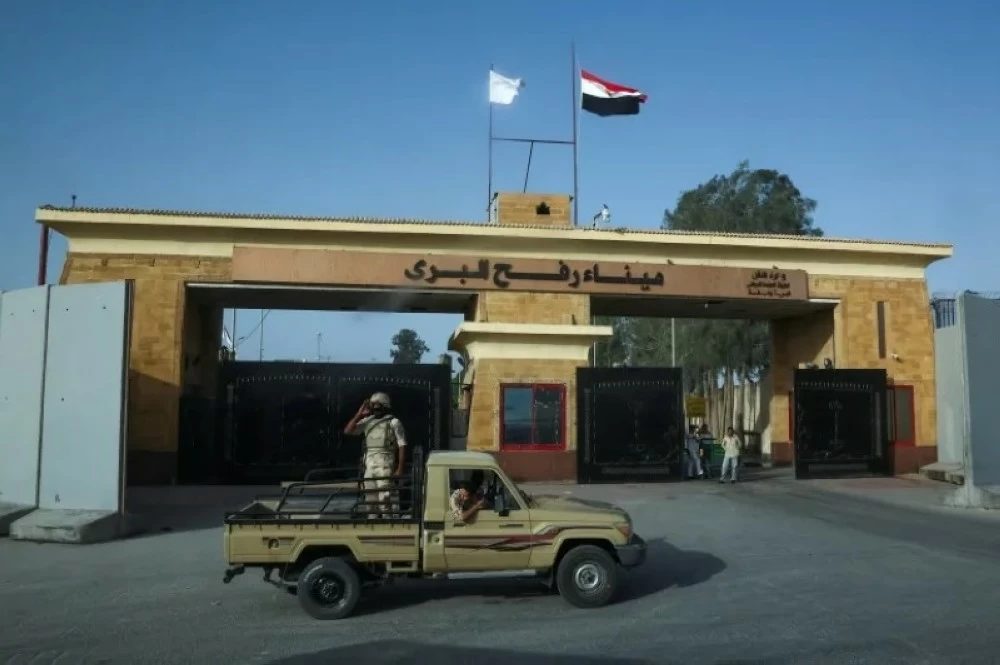
After nearly two years of closure, Israel today (Sunday) announced a limited opening for residents of the Gaza Strip to cross the Rafah crossing. Israeli media reported that the crossing was opened in the presence of representatives from the European Union and Egypt.
“In accordance with the ceasefire agreement and directives from the political level, the Rafah crossing has been opened to traffic only for residents,” the Coordination Office for the Government of the Palestinian Territories (COGAT) said in a statement.
He added: “Today, the first pilot phase began and was carried out in coordination with the European Union Border Assistance Mission (EUBAM), Egypt and all stakeholders.”
Agence France-Presse, citing three sources, said the Rafah crossing was opened on a limited basis on Sunday for the evacuation of the injured, and from tomorrow Monday it will be opened to regular passenger traffic, with an average of 150 people leaving the Gaza Strip and 50 entering it each day.
Ahead of the opening of the Rafah border, Egypt, through its Ministry of Foreign Affairs, called on all parties in the Gaza Strip to adopt “utmost restraint.”
Egypt condemned in the strongest terms Israel’s repeated violations of the ceasefire in the Gaza Strip, warning that these actions undermine efforts aimed at establishing calm and restoring stability and are a direct threat to the political course and success of the second phase of US President Donald Trump’s plan.
Meanwhile, Hamas called on the mediator to prevent Israel from violating the ceasefire agreement in the Gaza Strip. In extensive communications with mediators and international organizations, the movement condemned Israel’s continued attacks on the Gaza Strip, which it claimed were being carried out “under false pretexts and lies.”
The Rafah border with Egypt, the only land route into the Gaza Strip without going through Israel, has remained closed since Israeli forces took control of the Strip in May 2024. The Israeli military briefly resumed partially in early 2025.
After the ceasefire went into effect, Israel made the return of all hostages in the Gaza Strip a condition for reopening, which was completed with the return of the last hostage’s body at the beginning of the week. The US government has announced the move to the second phase of the agreement brokered with Egypt and Qatar.
The crossing is located in southern Gaza on the border with Egypt, within the area from which Israel did not withdraw after the ceasefire, more than half of the Gaza Strip.
Under the second phase of the agreement, the United Nations and relief organizations are calling for an unimpeded reopening to allow aid to enter the country, given the widespread humanitarian disaster experienced by more than two million people in the Gaza Strip.
After nearly two years of closure, Israel today (Sunday) announced the limited opening of the Rafah crossing to Gaza residents. Israeli media reported that the crossing was opened in the presence of representatives from the European Union and Egypt.
“In accordance with the ceasefire agreement and instructions from the political level, the Rafah crossing has been opened and restricted to residents only,” the Israeli Coordination Unit for Government Activities in the Palestinian Territories (COGAT) said in a statement.
It added: “Today marks the beginning of the initial testing phase, which will be carried out in collaboration with the European Union Border Assistance Mission (EUBAM), Egypt and all stakeholders.”
The Rafah crossing will open on a limited basis on Sunday for the evacuation of injured people, and will open regularly from tomorrow Monday for the movement of passengers, with 150 people per day leaving the Gaza Strip and 50 entering the area, French news agency AFP reported, citing three sources.
Ahead of the opening of the Rafah border, Egypt, through its Ministry of Foreign Affairs, called on all parties in the Gaza Strip to exercise “utmost restraint.”
Egypt strongly condemns Israel’s repeated violations of the ceasefire in the Gaza Strip, warning that it undermines efforts to stabilize the ceasefire and restore stability and is a direct threat to the political process and the success of the second phase of US President Donald Trump’s plan.
Hamas called on the mediator to stop Israel’s violation of the ceasefire agreement in the Gaza Strip. In intensive dialogue with mediators and international actors, the movement condemned the ongoing Israeli airstrikes in the Gaza Strip, which it said were carried out “under false pretexts and lies.”
The Rafah border with Egypt, Gaza’s only land route that does not pass through Israel, has remained closed since Israeli forces took control of the Strip in May 2024. It was temporarily partially reopened in early 2025.
After the ceasefire took effect, Israel made the recovery of all hostages in the Gaza Strip a condition for resuming transit, which was achieved with the return of the last hostage’s body at the beginning of the week. The US government announced the move to the second phase of the agreement brokered by Egypt and Qatar.
The crossing is located on the Gaza Strip’s southern border with Egypt, in an area from which Israel has not withdrawn since the cease-fire and covers more than half of the area.
Under the second phase of the agreement, the United Nations and humanitarian groups are calling for an unimpeded restart to allow aid to flow in as the humanitarian disaster affecting more than 2 million people in the Gaza Strip worsens.
