


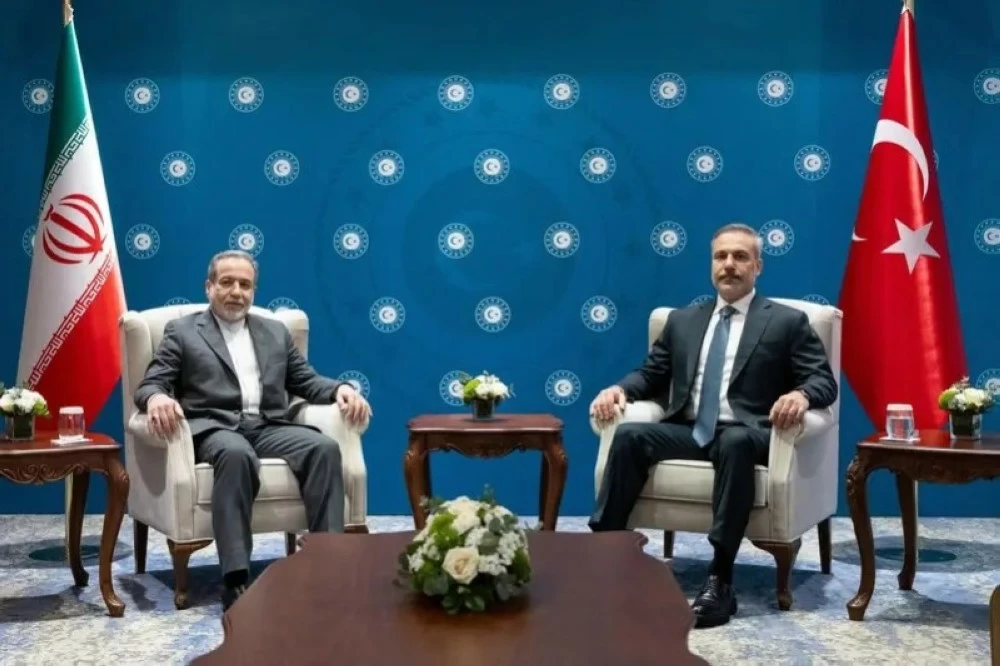
The Turkish President’s Office announced that President Recep Erdoğan spoke by phone today (Friday) with his Iranian counterpart Masoud Pezeshkian and informed him that Turkey is ready to act as a mediator between Tehran and the United States in order to reduce tensions and resolve issues between the two countries, while Iranian Foreign Minister Abbas Araqchi, who is visiting Ankara, confirmed that his country would not negotiate on defense capabilities.
A climate of mutual trust
Tehran’s state television reported that President Pezeshikian assured Erdogan that “the fundamental condition for the success of any diplomatic endeavor is the demonstration of good faith and renunciation of hostilities by those involved.”
The Iranian president said that establishing effective diplomatic channels requires creating a climate of mutual trust, stressing that Iran’s approach is “based on dialogue, respect, the logic of mutual interests and the refusal to use force.”
Arakçi met with Turkey’s Hakan Fidan in Istanbul, and in a joint press conference called on the United States and Iran to come to the negotiating table to resolve issues between the two countries, reiterating Ankara’s rejection of any foreign interference in Iran.
Prime Minister Turkiye calls for easing tensions
Foreign Minister Fidan said it was important to resume talks between the United States and Iran over its nuclear program to ease tensions in the region, and expressed hope that a solution could be reached that avoids conflict and Iran’s isolation.
He said he spoke with U.S. Special Envoy Steve Witkoff on Thursday and said he would continue to communicate with U.S. officials on Iran.
fair and impartial negotiations
In response, Iran’s foreign minister confirmed his country’s readiness to resume talks with the United States, provided the negotiations are fair and just.
“The United States has repeatedly called for dialogue, but negotiations must be fair and just, given that the American side is sending contradictory signals and military strikes are not the solution,” Arakuchi said.
Regarding the US threat to launch a military attack on Iran, Arakchi said the outcome of the negotiations cannot be predicted before they begin and that the nuclear program will not be included in the negotiations.
He stressed that the Iranian government has no intention of negotiating on its defense capabilities, and stressed that it will maintain and expand its defense capabilities. He noted that there are no plans or plans to meet or discuss with U.S. officials, and clarified that the Iranian side needs to “consider the preconditions and agenda first.”
Araqchi expressed hope that the United States would act rationally and logically, stressing that Iran is ready for both war and diplomatic scenarios. I’m even more ready than I was last June.
conversation and warships
Meanwhile, US President Donald Trump reiterated his intention to meet with Iran, even as the US sent warships to the Middle East and Secretary of Defense Pete Hegseth said the military was ready to implement any decision made by the president.
“There are a lot of big, powerful ships heading to Iran right now, and it would be better if we didn’t have to take advantage of them,” he told reporters at the Kennedy Center.
President Trump has repeatedly threatened to intervene if Iran continues to kill protesters. However, protests against worsening economic conditions and political repression have lessened in intensity.
The Turkish President’s Office announced that President Recep Tayyip Erdoğan spoke by phone today (Friday) with his Iranian counterpart Masoud Pezeshkian, in which he conveyed Turkey’s readiness to act as a mediator between Tehran and the United States in order to reduce tensions and resolve issues between the two countries. Meanwhile, Iranian Foreign Minister Abbas Araghchi, who is visiting Ankara, confirmed that his country would not negotiate on defense capabilities.
A climate of mutual trust
Tehran’s state television reported that President Pezeshikian assured Erdogan that “the fundamental condition for the success of any diplomatic endeavor is the demonstration of goodwill by those involved and the abandonment of hostile actions.”
The Iranian president said that establishing an effective diplomatic channel requires creating a climate of mutual trust, stressing that Iran’s approach is “based on dialogue, respect, win-win logic and the refusal to use force.”
Araghçi met with Turkey’s Hakan Fidan in Istanbul, and at a joint press conference called on the United States and Iran to come to the negotiating table to resolve the issue, reiterating Ankara’s rejection of any foreign interference in Iran.
Turkey calls for détente
Foreign Minister Fidan said it was important to resume talks between the United States and Iran over its nuclear program to reduce tensions in the region, and expressed hope for a solution that avoids conflict and Iran’s isolation.
He spoke with U.S. Special Envoy Steve Wittekoff on Thursday and announced that he would continue to communicate with U.S. officials on Iran.
fair and just negotiations
Iran’s foreign minister confirmed his readiness to resume talks with the United States, provided the negotiations are fair and just.
“The United States has repeatedly called for dialogue, but the negotiations must be fair and just, considering that the American side is sending conflicting signals and that a military attack is not the solution,” Araguchi said.
Regarding the U.S. threat of military attack on Iran, Aragushi said he could not predict the outcome of the negotiations before they began and that the nuclear program would not be included in the talks.
He emphasized that the Iranian government would not negotiate on defense capabilities, and confirmed that it would maintain and expand its defense capabilities. He noted that there are no plans or programs for meetings or consultations with US officials, and announced that Iran must “first review its preconditions and agenda.”
Araghchi confirmed that Iran is preparing for both war and diplomatic scenarios and expressed hope that the United States will act rationally and logically. “We’re more ready than we were last June.”
talks and warships
Meanwhile, US President Donald Trump reiterated his intention to meet with Iran, even as the US sent warships to the Middle East and Secretary of Defense Pete Hegseth said the military was ready to implement any decision made by the president.
“There are a lot of big, powerful ships heading to Iran right now, and we would be better off not having to use them,” he told reporters at the Kennedy Center.
President Trump has repeatedly threatened to intervene if Iran continues to kill protesters. However, protests against the deteriorating economic situation and political repression have subsided.
